
What If Death Isn't the End? A New Way to Heal Grief | Steven Ferrara ,Ep 227
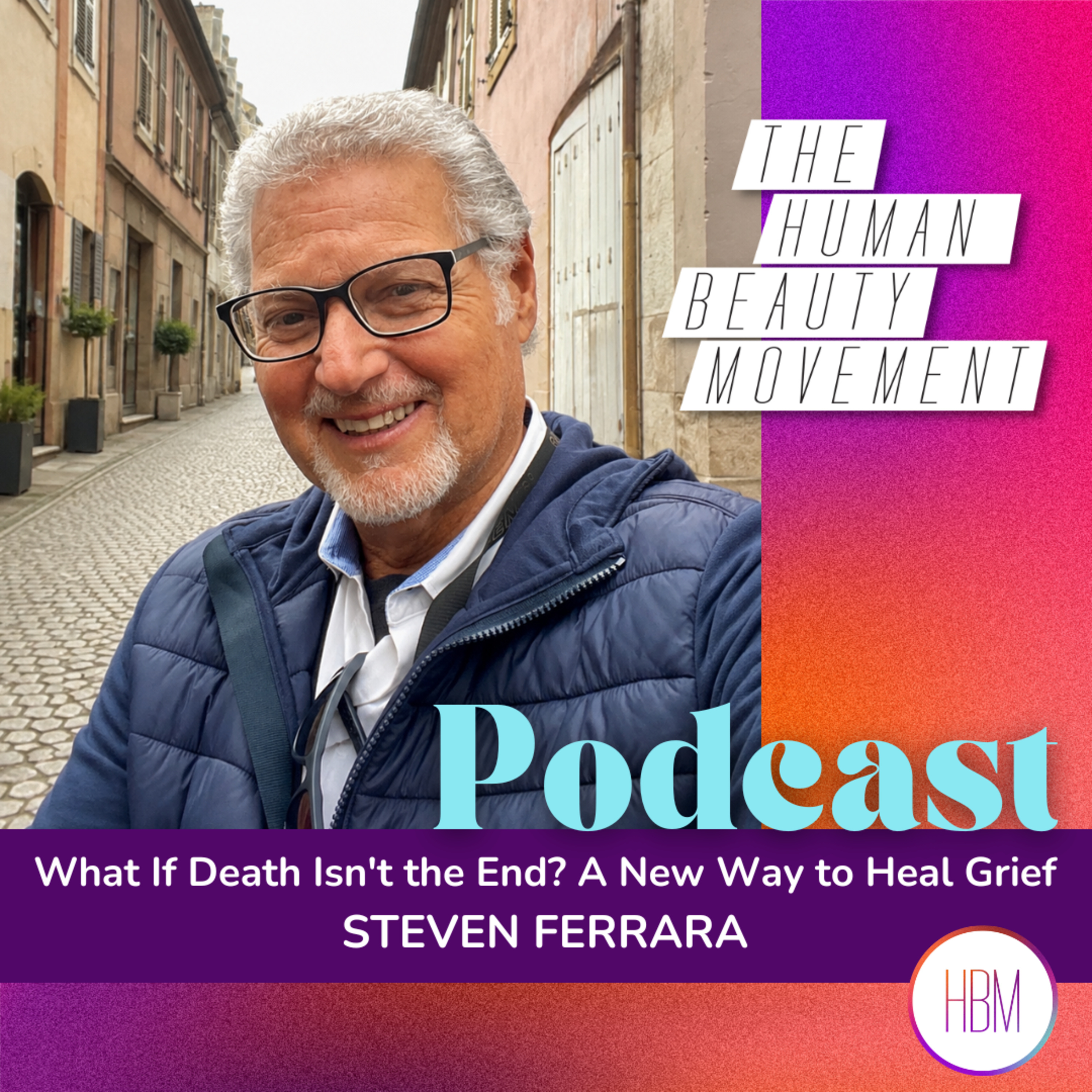


In this episode, Steven Ferrara shares his deeply personal journey of navigating profound grief through the loss of his son and wife, ultimately discovering that true healing is found by embracing pain rather than avoiding it. Together, we explore how gratitude, quiet self-reflection, and spiritual openness can transform suffering into a pathway for growth, connection, and deeper meaning. This heartfelt conversation reminds us that lasting beauty and peace arise from our willingness to approach even life’s darkest moments with curiosity, compassion, and the courage to love.
This podcast episode is sponsored by*:
- Humanist Beauty - Beauty for your skin & soul, Humanist Beauty is clean, conscious, and cruelty-free. Shop here → https://humanistbeauty.com
- SupeCaptainBraveMan - Super books for super kids! SuperCaptainBraveMan picture books are sweet stories that help build disability awareness for a kinder, friendlier world. Learn more → https://supercaptainbraveman.com
*The Human Beauty Movement may earn commissions from your support
Steven's Links:
- Website https://www.stevenferrara.com/
- Instagram https://www.instagram.com/stevenferraraauthor
- Facebook https://www.facebook.com/stevenferraraauthor
- Substack https://stevenferrara.substack.com/
The Human Beauty Movement Links:
- Official Website https://thehumanbeautymovement.com/
- YouTube https://www.youtube.com/@thehumanbeautymovement
- TikTok https://www.tiktok.com/@thehumanbeautymovement
- Instagram https://www.instagram.com/thehumanbeautymovement
- Facebook https://www.facebook.com/thehumanbeautymovement
- Community https://www.facebook.com/groups/thehumanbeautymovement
- LinkedIn https://www.linkedin.com/company/the-human-beauty-movement
- X https://x.com/thehbm_official
- Pinterest https://www.pinterest.com/thehumanbeautymovement
Jennifer Norman Links:
- Lnk.Bio https://lnk.bio/iamjennnorman
- LinkedIn https://www.linkedin.com/in/jennifernorman
- Instagram https://www.instagram.com/iamjennnorman
- TikTok https://www.tiktok.com/@iamjennnorman
- YouTube https://www.youtube.com/@iamjennnorman
- Facebook https://www.facebook.com/iamjennnorman
- Pinterest https://www.pinterest.com/iamjennnorman
- X/Twitter https://twitter.com/iamjennnorman
Thank you for being a Beautiful Human.
Jennifer Norman:
Most of us spend our lives trying to avoid pain. We fear grief. We resist loss. We ask, why did this happen? But what if healing isn't found by escaping suffering, but by walking directly through it? Today's guest knows this path intimately. Steven Ferrara is a nationally recognized speaker, spiritual teacher, and author of From Grief to Gratitude: Embracing the Inner Pathway to Healing and Peace. After the devastating loss of his 23-year-old son, then later after also losing his wife, Steven embarked on a decades-long journey through grief, journaling, meditation, spiritual study, and profound self-inquiry. Rather than allowing tragedy to define the rest of his life, he chose to let it transform him. He developed a profound understanding that now guides his work.
Jennifer Norman:
True healing is an inside job, And gratitude is one of our greatest teachers. Today, we're going to explore how grief can actually become a doorway to awakening, why gratitude is far more than positive thinking, how our relationship with those we've lost may continue long after death, and why Steve believes the inner pathway is ultimately the only pathway to lasting peace. So if you're grieving someone you love, navigating another kind of loss, or searching for deeper meaning in your own life, I think this conversation may gently shift the way you think about suffering and perhaps even about life itself. Let's welcome Steven Ferrara to the stage.
Steven Ferrara:
Thank you, Jennifer. I look very forward to our conversation.
Jennifer Norman:
Thank you so much for being here, Steve. Your story is incredibly personal, and you've chosen to share it publicly because you believe it can help others. So to start off with, I'd love to ask you, after everything that you've lived through, what do you believe is the greatest misconception that people have about grief?
Steven Ferrara:
Yeah, grief, and you summarized it pretty well in your introduction. Grief is part of the process, whether it's the loss of a loved one, as occurred in my life, or loss of relationship. People go through very challenging times, whether it's divorce, loss of a job, There's many things that we grieve at different levels in our life.
Jennifer Norman:
Mm-hmm.
Steven Ferrara:
And what I've learned is that the pain of grief is part of the process, and it actually opens a door for us to be able to walk through and find ways of moving forward from the intense emotion to ultimately finding a pathway, which is just little steps at a time to where we ultimately will find, as you said again, Gratitude is the great healer. One of the things that I would share off the bat is that many times when we're going through some form of grief, and I'll use grief of having lost a loved one as the example, we are very, very influenced, as we are throughout our life, by all of what's occurring on the outside, whether it be sympathy that we're being given, whether it's people feeling sorry for us. These are all just normal reactions that people will have. We receive So much stimuli from the outside. And what I found to be very effective is that you've got to give yourself time to find that inner pathway. That's why I named the book The Inner Pathway to Healing and Peace. There is an inner pathway where if we will find a place where we can commit to some quietness and some silence, what happens is so much of what goes on in our mind, thinking, the chatter, will calm down. And there are answers within us that that grief is trying to help us toward.
Steven Ferrara:
Almost any type of pain that we go through, it is a signal that we can learn something here. There's something to be learned. So if we look at grief rather than in a way where I just can't feel this feeling and pushing it away or denying it, but rather maybe with a more curious mind as to, hmm, This really doesn't feel good. In fact, it really hurts. It's very intense, but there's something in here and there's something for me to be able to understand in a bigger way about life and something to learn. So it's an opportunity to be able to move forward, see our life in a bigger way.
Jennifer Norman:
Such beautiful words. Thank you. And we'll talk a bit more details about that. First, I just want to honor your son. His name was Christopher. He was 23 years old and I'm Just curious because it sounded like he was your best friend. When I had read about you and seen a lot of the words and the interviews that you had given before, you had such a close relationship with him. And so it feels just like an unthinkable loss, an unthinkable amount of pain.
Jennifer Norman:
Can you tell us what happened inside you when you lost him that maybe nobody could see on the outside? What were you holding in?
Steven Ferrara:
Hmm. Well, as you said, Christopher and I were about as close as we could be. I'm sure many fathers say that about their sons, and I'm sure it's true. Christopher and I had some kind of a bond that I knew as soon as he was born. It was just this closeness. There was an understanding, unspoken understanding. We could, you know, had the same weird sense of humor. We could end each other's sentences.
Steven Ferrara:
We just enjoyed so much of the same things, so much in common. And we just, because of that, loved being together. And we were probably together more than most because he came into business with me and we were really enjoying that. Christopher was at the top of his game. He was doing great in his career. He was about to get married. Everything was perfect. I mean, Chris was a wonderful person, charismatic.
Steven Ferrara:
He was an athlete during his life. So he just had it all, which, you know, again, as a grieving father, maybe it sounds like I'm making it bigger than it is, but Christopher was something special. When he died in a car accident at 23, my Life felt shattered. There's no way to plan for how you would deal with an experience like that. Your entire life just goes upside down. You literally, for me, I just went into a deep grief, almost not believing that it was true for quite a while, but having to feel the anger. I was so angry at the universe. I used to be a runner and I would take these long runs on the country roads that we lived on and scream at the top of my lungs.
Steven Ferrara:
It was kind of a little— Winter country roads. Christopher died on December 18th, and for that whole winter, I would take these runs and be so angry at whoever, whether it's God or the universe. How can the universe or God take this perfect person out of their experience? It made no sense.
Jennifer Norman:
Mm-hmm.
Steven Ferrara:
And so that anger had to be expressed. Fortunately, I did have the physical aspect of running, but what I found is journaling became a very important part of me being able to express these feelings. I was an infrequent journaler before Christopher died, but then from the morning after he died, I daily journaled every single day for the last 20 years. And that's actually where the book emerged from. I never intended to be an author, but when I went back to read the journals, which I'd never done, I just would write and write and write, and then next day write and write, and I just never went back and read them. But a few years ago, once I had my career behind me, I had time and I had a big bookshelf of books, of journals. And so I started to read them and I was beginning to see how some of the things that I was living, there were actually turning points that I had some revelations, so to speak, of how I could look at this unimaginable experience in a different way. And as I began to see even my journaling shifting over time to where I was beginning to realize that I can have this ongoing and growing love and experience with my son Christopher.
Steven Ferrara:
And so the things to go to your question, I don't know that anyone can truly express how they're feeling in grief. I think everyone has their own way of going through it. And I think we have to respect everyone in the way they go through it. But what I found in my life is that I was not going to use this almost unimaginable experience of losing my son, the most traumatic thing that has ever happened in my life, I decided early on, I am not going to allow this enormous experience to just have the effect of me feeling sorry for myself. There has to be something more here. And so I'm going to use this as a way for me to find more meaning in my life. And that was kind of a beginning. Of me being able to make this journey that is still ongoing, but that real commitment that I was not going to let such a huge experience in my life just have the effect of feeling sorry for myself.
Steven Ferrara:
It didn't make sense.
Jennifer Norman:
You said so many things and I want to unpack a few of them because I think that they're really worth pulling into present in terms of just things that I think might be helpful for people. Number one, The anger and letting it out, the screaming, the running, the doing something to release that is, seems like it's an important part of it and not bottling it in potentially or ruminating on it and holding it inside. Letting it out seems to be key theme, whether it be from a physical activity or in your other case in journaling, that seems to be another way to cathartize and release emotions. in perhaps more of a, like a mental emotional way than a physical emotional way. And so both are absolutely valid and can be helpful in so many ways. Another thing too is you were mentioning, and I know that we hear the phrase so much, is like there's no right or wrong way to grieve and people will grieve in different ways, which is true. Yet I think from the outside, sometimes we say, oh gosh, that person went through a terrible loss, but shouldn't they be over it by now? Or maybe we think to ourselves, if we're grieving, I should be over this by now. Or alternatively, we might say, I will never get over this.
Jennifer Norman:
This pain is too great. And you feel like you just wanna die. You feel like it's just too much to bear and you may, you may just succumb to it. And so I think that the intent here is to respect and honor everybody's way to grieve and also provide healthy ways to go through it. to move through it rather than to numb it or to cut it short, to repress it, to continue to ruminate over it and build and build and build so that it really is debilitating for you. How would you describe from your book and talking about the inner pathway, the healing process that you've come to know that you think has been so helpful for you?
Steven Ferrara:
Yeah, well, as you've mentioned, we all grieve differently. And what I had realized is that I need to feel this grief rather than deny it or push it away, and not to engage with it, meaning that I'm going to turn this into a big story that's even worse than it is, but to embrace it. It's very different to embrace a feeling as opposed to engaging with it and then turning it into an emotionally charged story of poor me and I lost my son, and there's a million storylines that are imagine that can end up on a dead end. And we do go through that. All of the what-ifs, I should have, I could have, I would have. I mean, those are grieving questions.
Jennifer Norman:
Yes.
Steven Ferrara:
But what I found is when I have this feeling, if I can embrace the feeling and know that it does not feel good, this is not a good feeling. It's an uncomfort, but it's not going to make me jump out the window necessarily. I was not inclined that way, but I knew this feeling was really just an intense one that I did not want to push away. I needed to embrace and I needed to express it in healthy ways. We already talked about the journaling and the running. I also found a couple of people in my life who was very fortunate. I talked about my dad in the book. He was a person that turned me on to spirituality when I was 10 years old.
Steven Ferrara:
Thank God he was still here. I had a good 8 or 10 years that I was able to have him as somebody that I could express to. And early on, we'd spend hours And I just had to express. And I also have a sister and another friend that they weren't going to give me sympathy, but they were going to give me understanding and an openness. And that's another key. Sympathy is everywhere, and that's the way our society is designed. And it's okay. People are doing the best they know when they say, give you my condolences, my thoughts and prayers.
Steven Ferrara:
I'm so sorry for you. I mean, that's fine, but it's not what I needed. I started to take a few steps forward. I didn't want sympathy. I wanted somebody I could just express to and be able to have them just understand to the best of their ability. Sometimes just be very quiet and listen as I express myself crying through my words or whatever it may have been. Also finding— I mentioned earlier quiet time— so critically important because the mind will just loop and loop and loop about the would-haves, could-haves, and should-haves. And you need to Cool those jets.
Steven Ferrara:
And again, I was very fortunate. I grew up in the '60s, so Transcendental Meditation came into America. I took a class when I was 17, so I had that meditation as a tool. And so I was able to use that to help me just quiet and be in peace. And even if it was just for a few minutes every day, and, and, and so much stuff would still go through my head, but I was able to quiet myself and try to be more in touch with deeper feelings than all the thoughts that may have been passing through. So that was another important part of my moving forward, the quiet time. I would take walks. We lived in Florida near the beach.
Steven Ferrara:
We'd just take walks on the beach and be in nature and see the beauty of the ocean and the sand and the palm trees and the sun and the air and just take that all in and find gratitude Those things. So it was all of those types of things that enabled me to slowly realize there's another pathway. But it does take a commitment to want to move forward because the pull and the attraction of staying in sympathy, of staying— and I hate to say it this way, it's a bit harsh— but staying as a victim, as opposed to saying, hey, I can learn something here. And not that it's that easy to do, but it's a curious mindset as opposed to— Opposed to a victim mindset. That is important to realize you can move toward. After all is said and done, it's a choice. I often tell people, your superpower, our superpower as human beings, is we have the power to choose. I can choose how I want to experience life no matter what the outside does.
Steven Ferrara:
I can choose. And that's a superpower that we have that sometimes many human beings don't take that responsibility and they just allow the outside to dictate to them. But when you come to a more inner pathway, you are taking in whatever's coming in, but you're choosing how you're going to respond to it. And we always have the choice to respond from our higher self, which is usually based in more gentleness, compassion, and ultimately love, or the more lower self, which is usually based in the fears and the worries. And it's always our choice.
Jennifer Norman:
Yeah. A lot of people say that when they lose a loved one or something devastating happens, if they feel like they've moved on, quote unquote moved on, then there's almost a feeling of guilt because they feel like they're dishonoring the person who they've lost or something to that effect. Like it almost means like they've forgotten about that person. And so staying in the grief helps them in some way to feel closer or that pain associated with a bond with that person that they've lost. How do you respond to that?
Steven Ferrara:
Yeah, it's a great question. That's— I talk about this in my book in that we have a very twisted way of looking at guilt. Somehow, at least in my life, I did grow up Catholic for a few years. Guilt was a good thing.
Jennifer Norman:
Catholic guilt.
Steven Ferrara:
I think every religion has it in some way, shape, or form. And somehow it's been twisted in our society that guilt is a good thing. Feel guilty if you've done something wrong, feel guilty. And What I learned is there is nothing that is more opposite than that. And I'll explain that in that the love that I have for my son and my wife, by the way, but my, my son is who we're talking about, and he was first one to die. So this is where I learned so many of these lessons. The love I had, I have for my son is about as close to unconditional as I may have ever had for anyone.
Jennifer Norman:
Mm-hmm.
Steven Ferrara:
We just accepted each other unconditionally.
Jennifer Norman:
Hmm.
Steven Ferrara:
And it was because of that level of love that I realized that that love that I feel is the love I share with my son. Love is not about getting anything. Love is about giving. Love is always about giving. And that's another misunderstood thing. Oh, my husband needs to love me. My children need to love me. No, you need to share your love with them.
Steven Ferrara:
That's the only love we feel. I really don't know what my children think. I mean, I hope they love me. I think they do, but I don't feel their feelings. I feel my feelings. And so by me sharing my love, I would be able to continue to feel that bond of love with my son.
Jennifer Norman:
Mm.
Steven Ferrara:
And that was a very important revelation, I'll call it, because I realized that love does not have to be and can only exist when someone's physically here. You don't have to be physically here. I mean, even when my children— I have 2 daughters and I haven't seen them in 2 weeks. They live in Florida and New Jersey. I love them just the same, even though I'm not physically seeing them. Now, it's a little bit different when the child dies because you can't just pick up the phone or FaceTime them or something.
Jennifer Norman:
Right.
Steven Ferrara:
But same deep feeling within is still there. And that can be continued to be felt, which I love my son as much as I ever have. I know that I've got ongoing and a growing relationship with him and guilt. All I can say We have to be willing to look at it in a different way because unfortunately our society has trained us. Some religions have trained us that guilt is the only way that we know that we love somebody. And that is so— I mean, it's like saying unless my wife is jealous of me, she doesn't love me. And there couldn't be a more— jealousy is a negative based in anger. How could that be love?
Jennifer Norman:
Yeah.
Steven Ferrara:
These are the twisted ideas that we're programmed, you know, from the day we're born. Plus we are a product of humanity, of the universe, and so we got a lot of stuff in there.
Jennifer Norman:
Yeah.
Steven Ferrara:
And it's not all right. In fact, a lot of it is, is just limitations and blockages that we've picked up along the way that we have to be willing to look at when we feel them and maybe just let them go at times and try to see that experience in a different way. And if we truly do want to see this experience in a different way, new ways of looking at it, we open up space within our head and looking at something, comes up. It's not that you think about it, it just occurs.
Jennifer Norman:
Yeah. And then alternatively, if you're not feeling guilty because you feel that you should be grieving more and ongoing for this person, if you're a parent such as yourself with other children, if you've got a job that you've got to focus on, then you feel guilty if you're— if you're showcasing grief. Sometimes you're like, I've got to be strong for the people that are around me now. I've got to be strong and show a professional face for when I go to work. And then you bottle it up inside and you kind of just not necessarily letting it to be fully expressed because you feel that you have to be your quote unquote best self and play that game, play that charade, that part so that everybody sees somebody that is strong and, and not necessarily vulnerable and in pain. And that has its own set of issues too.
Steven Ferrara:
It does. It does. But again, I think there's some very important steps that I would offer At least a couple right up front.
Jennifer Norman:
Please.
Steven Ferrara:
Someone to move through those early stages of grief. And one thing I learned many, many years ago through spirituality is that life is unfolding perfectly. Life has been unfolding for 14 billion years, if in fact there was a Big Bang, and it's been unfolding for 14 billion years perfectly. Our little planet, our little tiny, tiny planet Earth is here for 14.5 billion years. Us human beings just came onto the scene a couple hundred thousand years ago, we are infants in this grand scheme, 0.00000001 of the time the universe has been here, but it's been unfolding perfectly over all of those eons of time. Now, all of a sudden, because I'm here and I'm self-aware and I can have opinions, why would life come to me and say, hey, do you agree with what we're, what I'm doing? Or why would life even ask my opinion? It never has. It never will. And it's just gonna keep on unfolding.
Steven Ferrara:
So when I had to come to the realization of is I could fight with life all day. I could resist it. I could push back. I could continue to ask why, but that just created more and more suffering. It's a losing battle. Now, while I'll never agree, frankly, that my son was taken out of his human experience at 23, I did have to accept that this was the way life unfolded. I'll never understand why, but I do need to accept That life unfolds perfectly. This universe, there's just no way that it could make mistakes.
Steven Ferrara:
It's just too perfect, especially if you look up at the universe and see all that there is. And so you need to get to a point where you can at least accept, don't have to agree, but we do need to accept that life is unfolding the way it's supposed to. Why was my son's destiny only 23 years? I don't know, but I accept it. Because it occurred. And if it happened, then it was supposed to happen. And so, and in a more general way, I always think to myself, no matter what the situation is, that life is not here to torture me. Life is here to teach me. And it's an important thing to remember because if we know that life has been unfolding, life loves us.
Steven Ferrara:
Frankly, I feel life loves us. It's not here to beat us up, even though life Just normal life gives you challenges, but those are challenges for us to learn from and for us to grow from. Most people that you talk to, many times they'll say, you know, 5 years ago when I got divorced, it was the worst thing that ever happened, but thank God it got me to this person and or whatever, or a job that you got fired from and all of a sudden 3 years later you're in the best thing you've ever been. I mean, we hear stories like that all the time. So if we can realize that, yeah, these challenges are occurring and built into them, built into those challenges are those opportunities. Not easy to do.
Jennifer Norman:
Mm-hmm.
Steven Ferrara:
As traumatic as the death of a loved one, but at least starting from the premise of, okay, well, life's not here to torture me, it's here to teach me, and life is unfolding perfectly. So I am not going to continue to just push back, but I'm going to at least stay open and see where this is supposed to be taking me. And that's where journaling and the stream of consciousness became more pure. It wasn't just feeling sorry for myself and just totally focused on me. It was just stream of consciousness about what is this? Where is this taking me? What is there to learn and hear? You know, and even as I said those things, I didn't believe them, but I just kept writing. And when I needed to express at times the anger, I'd scream. And fortunately, again, as I say, finding people or a person in your life, I even got involved with book clubs, not necessarily for grieving people, cuz I just was never attracted to that. But it was for more spiritually oriented groups, like people studying A Course in Miracles, which is a pretty famous book out there.
Steven Ferrara:
Been around for a long time. It's another one called The Way of Mastery. There's just book clubs out there where there are spiritually oriented people. There's authors that speak about death very clearly, but in a much higher consciousness way. And that's what I was trying to just kind of— open myself up to. I just wanted to be aware of other ways of looking at this.
Jennifer Norman:
Speaking of spirituality, do you think that that was helpful for you to get to a place of gratitude earlier than otherwise? Does that also help to fuel your ongoing relationship with Christopher today?
Steven Ferrara:
Yeah, absolutely. I will tell you though, that I've been exposed to spirituality, as I said, since I'm 10 years old, where people, books, I've always enjoyed reading. So I've always had books around. I've gone to so many classes. I've taught spiritual principles. But when I was 49 and my son died and he was 23, all that stuff went out the window. Nothing made sense anymore. Spiritual, smirritual.
Steven Ferrara:
It's like nothing helped in the early stages. Totally get it. Yeah. And in hindsight, I realized that was just part of the process. You got to go through that. It's like you're trying to build muscle. Well, you're going to hurt if you're going to really work those muscles. And maybe a bit of a shallow example, but But still the same in that you're going to go through pain.
Steven Ferrara:
You're going to go through grief, sadness, whatever way it expresses, but it's not an ending. It's a doorway opening. And so the spiritual foundation that I had, while I threw it out the window initially, it was just part of my life. And I got redrawn back to not only being a reader, but a voracious reader. I just decided I'm going to pick up books on near-death experiences. I want to know maybe what my son went through when he died. I read tons of that and so many examples, which is so beautiful of people coming back. And every one of them just didn't want to come back because it was just so beautiful and loving, but it wasn't their time.
Jennifer Norman:
Right.
Steven Ferrara:
Obviously it was my son's time. And if he was feeling any of that, how could I be anything but happy for him? You know, when I began to look at it from my son's side of the experience, rather than just focused on me and from my side and for those of us left behind, it's sad. There's no two ways about it. And I still till this day feel sad if I see a father and son on a golf course and it's like, man, but I won't go. I've programmed myself that I don't, don't go down dead ends anymore. Like, oh, that could have been, but no, I just see it. Okay. I feel sad.
Steven Ferrara:
That's okay. I'll keep moving forward. Sadness is okay. It's not going to kill me, like I said before. But the idea of being able to just allow yourself to know that you can move forward, the spiritual foundation I had certainly did help because I was more drawn to people and books like that. And I found the Course in Miracles people and I just looked for that. If someone doesn't have that spiritual background, maybe it comes in the form of their religion and finding a good group of people that are more inspirational and uplifting as opposed to just dwelling on the circumstances. The circumstances, that's what occurred.
Steven Ferrara:
It's how we respond to those circumstances. And there are so many groups out there that are uplifting and inspirational.
Jennifer Norman:
Mm-hmm.
Steven Ferrara:
Person wants to find them. So yeah, my spiritual background was enormous. And just end with saying this about the spirituality part of it is that I truly began to know that Christopher was not only my son, and in fact, I saw this very clearly in my journals, maybe 3 journals in, about a year and a half or 2 years in. I always signed off in my journal, love forever and eternity, Dad. And then I started signing off, love forever and eternity, Dad, and your spiritual partner. And I began to see Christopher as my spiritual partner.
Jennifer Norman:
Mm-hmm.
Steven Ferrara:
And Gratitude began to come in because now it was a celebratory thing. I have a spiritual partner that I know I love and I am so bonded to that's on the other side. And here I still am in my human experience, but we're together walking down this path. I can help him. He can help me.
Jennifer Norman:
Mm-hmm.
Steven Ferrara:
And that was a huge breakthrough to begin to look at Christopher as not only my son, but my spiritual partner that I was walking on this path with.
Jennifer Norman:
Wow. Because so many people and our culture often treats death as an ending. And this sounds so much more like a transformation, that it's a realization and that it's actually something that's uplifting and unfolding and is something that helps to drive you with passion and joy rather than the grief and the suffering, or perhaps simultaneously. I'm not sure, but it does sound like it's something that is very special that you've come to know is true about you and your son.
Steven Ferrara:
Yeah. I mean, the sadness, as I mentioned, is still there. What I've also realized, somehow we've gotten this strange perception that life is supposed to be wine and roses every day and laughing and fun. That's not life. You know, that's not life. I mean, maybe social media tries to portray it that way. And that's why people get a misconception.
Jennifer Norman:
Yeah.
Steven Ferrara:
It's like in my day watching Leave It to Beaver, Father Knows Best. I mean, it was a perfect family. That wasn't true. You know, it's not, you know, most families are dysfunctional, but you know, you, if you want to compare to what people are portraying, then you begin to think, well, that's the way life should be. Why don't I feel that way? No, the way you feel is the way life is supposed to be. There are wonderful, joyful times in life and there are challenging times in life. It's just the way the human experience is designed.
Steven Ferrara:
I truly believe that this human experience of 80 or 100 years or 23 years in my son's case, it's designed to be a classroom for us to be learning. There seems to be no other reason to be a human other than to learn. I mean, we procreate, we're fathers or mothers, we're husbands and wives, but the biggest of purposes is that we are here to continue to learn. And in my opinion, to continue to get closer to our spiritual essence and truly know that we are spiritual beings having a human experience. And so, but feeling sad, sadness, like fun, is overrated. You know, most people, if you think—
Jennifer Norman:
Sadness is overrated?
Steven Ferrara:
It's all overrated. You know, how many people, you know, when you talk to somebody, oh, we had so much fun, blah, blah, blah, you know, they're just telling the 10,000-foot view. At ground level, they didn't have fun every minute of that time, and they probably had a with a long line to get into the event or whatever the case may be. And sadness, on the other hand, is overrated. As long as we don't engage with it and turn it into something that mixes with our thought and now becomes poor little me, I lost my son. Those are dead ends that go nowhere. We have to remind ourselves that I'm so grateful, firstly, that I had 23 years with my son. I could have not had a son, but I had 20 3 years with this amazing, beautiful son.
Steven Ferrara:
And now I've got a lifetime of learning with him as my spiritual partner. And who knows, maybe we've traveled together before, we'll be traveling together after. I don't know anything about that stuff, but I know how I feel now. And I know that I'm moving forward each day with him as a spiritual partner. And feeling sad is just, just one of those things that happens. So don't make it more than it is. It's a feeling.
Jennifer Norman:
I want to talk about gratitude for a minute because some people think that gratitude is positive thinking, or sometimes it's pretending everything is okay. What do you think that authentic gratitude is actually like?
Steven Ferrara:
Yeah, gratitude is an interesting thing because I think most people that you talk to, they're certainly grateful for the food they have on their table. They're grateful for the house they live in. Probably they're grateful when it's a sunny day. They're grateful for those types of things. And that's what Wonderful. And people should be grateful for all of that. But gratitude is far deeper than that. Gratitude is actually a way of living your life.
Steven Ferrara:
It's actually a way of being, meaning that no matter what occurs in your life, even when the challenges come along, if you're going to be grateful for your life, then you got to be grateful for every aspect of our lives, including the challenges.
Jennifer Norman:
Mm-hmm.
Steven Ferrara:
And to look at a challenge in our life, whatever it may be, it could be a tiny little thing like, you know, we got mad at the guy that's driving 10 miles an hour too slow in front of us, on up to major challenges. If we can look at it as, that's interesting. It's an experience that I'm feeling, and I can be grateful for that experience because I do have the ability to be aware of the experience, but I can relate to it in any way that I want. The little old man in front of me, maybe my first reaction is, oh, come on, get out of here. But then my awareness comes in and I can be You know what? It's my grandfather in front of me. He's a 90-year-old guy that can't barely see or whatever. Or, you know what? I'm going to just enjoy the trees that go by. I'm going to enjoy nature.
Steven Ferrara:
I'm going to enjoy the radio show. It's just a matter of choosing to look at a situation in a different way. So gratitude is a constant. It's a way of being. It's a way of living your life through thick and thin. And maybe more important through the tough times than through the easy times. It's wonderful to have the good times and enjoy them and love them. But when the challenges come along, if we can look at them with an open mind, with a curious mind, and with ultimately a mind of gratitude for the experience.
Steven Ferrara:
You know, I often say, people say, well, you're grateful that your son died? No, not at all. I wish my son was still here. But what I'm grateful for is the experience and all that it continues to teach me and has literally changed me into a better person.
Jennifer Norman:
That's an important nuance. A very, very important nuance. Yeah. I'm curious when, of course, after losing your son, you went through this whole entire grieving process and learned so much. Your wife passes. Was the grieving process similar or do you feel that once again, you went back to ground zero and You know, threw everything away again, or tell me what it was like, because some people would think that it's just unbelievable that you could have 2 devastating losses like that in a lifetime.
Steven Ferrara:
Yeah. Well, my wife, Allie was her name. She died very quickly of an illness we didn't know she had. And once she was diagnosed, she died 7 weeks later. It was devastating, as would be expected. Allie and I were together since we were 20 years old. We grew up together. Our lives were so just intertwined, everything.
Steven Ferrara:
I mean, me and Allie were, you know, like one person to our children, to our family, to our friends. It's Allie and Steve, Allie and Steve. We had found a very traditional way that we grew up where I was the provider. I always said I made a living, but she made the life. She was the one that truly put it all together and was the cornerstone of our family.
Jennifer Norman:
Mm-hmm.
Steven Ferrara:
Cornerstone of it all. I just want to make some money and she did the rest. I just showed up. It was a wonderful, amazing, almost 40-year relationship. So it's different when a spouse dies because you've lived together all those years. You know, my son was off a little bit on his own, already independent. My day-to-day, except for in the business, was not every minute with him, whereas with Ali, every minute of my life, it was intertwined in some way, shape, or form. form, or even just calling each other, hey, I'll see you at 6 o'clock or whatever.
Steven Ferrara:
So yeah. And from the very practical of when she died, my life was upside down. I didn't even know how to use the washing machine, all the way up to waking up in the morning and she's not there by my side or going to sleep at night and she's not by my side or not having someone to just say anything and talk to and know that she loved and supported me no matter what. So that was a tough one. Thank God, I guess. That I had the years of experience of understanding that there is a pathway that I learned from Christopher's death. But again, other than just being aware that I will get through this, I still had to go through it. And in some ways could have even been tougher because of our intertwined lives, trying to unentangle that and become an individual.
Steven Ferrara:
It's not easy. That's what people go through. Yeah. But I knew that again, I was, I guess, aware enough at that point that I knew to look at this from Allie's side. Allie was a tennis player. She was in great shape. That's why they never diagnosed her until she, till we finally got her to a place that looked a little deeper, but her life was wonderful. And then when she died 7 weeks later, my first feeling was to be happy for her.
Steven Ferrara:
That she didn't have to suffer. She would not be one to want to linger around for months and months or years. Dying in seven weeks, while it was so tough for myself and my daughters, especially losing their mom at a relative young age, I knew for Ali that I was happy for her that she didn't have to go through prolonged suffering. And again, I don't know where the journey takes you, but when you have a body. That has kind of fallen apart on you. I just felt good that she was able to take that body off, so to speak, and go wherever you go. It was a feeling of happiness for her, even though terrible sadness for me. But I did know that there was a pathway, and very much the same pathway I took with Christopher, although I was discovering that pathway each inch.
Steven Ferrara:
The way I kind of knew that there's a pathway and I won't ever say it was easy, but I at least knew where I was headed to some extent. It wasn't just blindly discovering things at each turn. In some ways, to be frank, I almost felt like I pushed myself through too quickly and I had to realize, you know what, I got to allow myself to grieve. You know, even though I know there's a pathway, This is just such a, again, an unimaginable thing to occur. I've gotta allow myself to just move into this in a proper and appropriate way and not push myself faster than I should have, should have gone. So I think knowing there's a pathway helped, but it also made me think, all right, well, I gotta move through this. And that's not the case. You've gotta move through it at your pace.
Jennifer Norman:
Hmm.
Steven Ferrara:
But knowing and always being committed to knowing that there's a pathway and a healthy one to keep moving forward. Life goes on. You can be joyful again. You can be happy letting go of some of that guilt or even with a wife, I could have been a better husband. I should have done this. I would have done that. You know, all of that stuff got to be let go. You did the best you could to the best of your ability.
Steven Ferrara:
And now you're at where you're at. Your spouse is on their journey and you're on your journey. And the reason, you know, I'm 71 years old and I'm still in my human experience. My son is not in his and my wife is not in hers, but I'm still in mine. So I'm willing to do the very best I can each and every day to make this experience, you know, a worthwhile one.
Jennifer Norman:
Beautiful. Your book, From Grief to Gratitude: Embracing the Inner Pathway to Healing and Peace, does lay out some steps along that pathway. Can you share, just abridged for our listeners, what those steps are so that they can get an indication of what they can learn in your book?
Steven Ferrara:
Yeah, it's really just a sharing of my journey. It's not by any way a tutorial. I would never do that. All I know is that I shared what my journey was and the life lessons I learned along the way. At the end, And I thought maybe it would help. I tried to summarize it into 8 steps, but it's hard to say. Everybody makes their own steps, but it sounded like something that might be helpful. So I ended it that way.
Steven Ferrara:
But the book itself is really what is sharing each and every step in the detail of the way. But as far as the steps, we've talked about a few of them already. First and foremost, we have to come to the understanding that life is not here to torture us. Life is here to teach us. Life is unfolding perfectly. It's something that most of us would not agree with. You know, if you listen to the news, well, how can you say that life's unfolding perfectly when people are being killed and, you know, wherever?
Jennifer Norman:
Yeah.
Steven Ferrara:
Yeah. And it's a good question, but I'm, I don't know enough to be able to answer that other than life cannot be happening by mistake. God is not Punishing anyone. Sometimes things that happen, again, when you look back, it was the best thing that ever happened. And I'm not saying anyone should ever die, but that's life in this planet Earth that we're still a bit barbarian. And situations occur that look really horrible to us as an individual when we relate to it, but we don't really know how people are experiencing things. And as an example with, I think too many of us think about stuff. We think about what something may feel like or look like.
Steven Ferrara:
You really don't know until you experience it. Like, I till this day have people that tell me, oh my God, you were dealt a horrible hand. Your son and your wife died. And at this point, it just like bounces off my head. Like, I've been dealt a horrible hand. I, I guess if I want to look at it that way, as a, from the human side of things, but in the bigger scheme of things, those were experiences that occurred in my life.
Jennifer Norman:
Mm-hmm.
Steven Ferrara:
And they've helped me continue to grow to become someone that I may not have been able to become had I not had those experiences in my life.
Jennifer Norman:
Mm-hmm.
Steven Ferrara:
So, so firstly, looking at life as a teacher. Life's to love us and teach us. Life is unfolding perfectly. A very important piece, and I've said this already, but I can't stress it enough, we've gotta take the focus off Looking at this from our side, which was absolutely a sad side, we're left behind. But look at it from the other side. Look at it from our loved ones' side. Many times people die at, you know, moms and dads die at a more natural age. For them, it's a relief.
Steven Ferrara:
80-some-odd years old. If we, if we were born, we gotta die at some point. And dying at 80, 85, 90 years old, that's a pretty damn good life. And I think in some ways we should celebrate that. And I think we're getting a little bit closer to that as a society. We're still a ways away, but we can celebrate them while still feeling sad that we lost them. It's okay. We can still continue to love them.
Steven Ferrara:
That bond of love continues beyond the human experience, beyond the physical experience. So, you know, those are some just basic things, but there's 8 steps there that are kind of a summary of a pathway.
Jennifer Norman:
Beautiful.
Steven Ferrara:
that someone, you know, can choose. And I think it's a healthy pathway that'll get someone to a place of healing.
Jennifer Norman:
Oh, thank you so much for that, Steve. So ladies and gentlemen, if you are interested in hearing about those other steps or just learning a little bit more about Steven's path to healing through grief, then definitely pick up his book, From Grief to Gratitude. And I think that you can get it on Amazon. You can probably get it wherever books are sold. It would definitely be helpful also as a gift for somebody that, you know, might be going through a grieving process right now. So Steve, at the end of my podcast, I always ask my guests 3 common questions. It's very interesting to hear the similarities and the differences between these responses. My first question is, what makes you beautiful?
Steven Ferrara:
Thank you for that. And that is a wonderful question. I think what makes me as well as everyone beautiful Is when we begin to realize that we are not just someone that has to react to everything that goes on on the outside. We have this beautiful higher self within us that no matter, again, what I said before, no matter what's occurring on the outside, we can respond. Even the strong emotions, the angers, the worries, the jealousies, they are not who we are. We don't have to identify ourselves as an angry person. Identify myself as someone who lost this child and I'm sad. Those are not identities.
Steven Ferrara:
Our true identity is we are far greater beings than any of those emotions. And the thing that helped me realize that is as I would go more into my quiet self, I'd realize, you know, if I can observe those things and see that they're passing through, then I must be something greater than them because otherwise I couldn't observe them. And that just became a very practical thing of, oh, then I must not be them. I feel them, but I don't have to identify as them. So we can identify from the highest place we can from within. I think that makes everyone a beautiful person.
Jennifer Norman:
Oh, what a great answer. Thank you so much for that. My next question, what does it mean to be human?
Steven Ferrara:
Hmm. Yeah, another good question, Jennifer. You're very good with these questions. I think it's said scientifically that it's 1 in, I don't know, 4 trillion that we could be born a human. Scientifically it's 1 in many trillions. If you look it up on Google to become a human with all of the enormous amount of variables, starting out with conception and the millions of, you know, and all the things that can occur in the ancestry and about. For us to be here as a human being is so amazing.
Steven Ferrara:
And we need to look at this human experience as something to be so grateful for that somehow, some way, all the cells and everything else came together for me, Steve, to have this human experience. And I could not be more grateful I landed on this beautiful planet Earth with all of its trees and animals and all of its gorgeous beauty. I could have landed on Mars. There's no fun on Mars. Or could have, who knows, I could have landed on some other planet that may, but we got this amazing, beautiful blue planet Earth.
Jennifer Norman:
Yeah.
Steven Ferrara:
Wonderful is that I am just going to enjoy my life to the best of my ability and, you know, and handle the goods and the bads and know that being a human, to answer your question, means We are a student. We are here to learn.
Jennifer Norman:
Oh, amazing answer once again. And then my last question here is, what is one truth that you live by? You've mentioned several during the cast. And so I'm curious if there's a separate one that you might be able to offer to our listeners.
Steven Ferrara:
Yeah, I've shared many of the principles that I live by. And I guess the one that I can't say enough is to know that I am a spiritual being having this human experience. I am so fortunate that somehow, some way I showed up at this time of life and I may have chosen as a spiritual being to want to be here. Who knows? I don't know enough to say that's right or wrong. I have my own feelings and beliefs, but knowing that I'm far greater than this human experience. Knowing that I'm on a journey. The human experience starts with birth and ends with death. Life, though, continues on.
Steven Ferrara:
And I think that's an important thing for people to realize, that life and death are not opposites. It's birth and death. Life is eternal. It continues on. And we're part of that. So we continue on as spiritual beings wherever that goes. I don't know, but life does continue on.
Jennifer Norman:
Well, Steven, I really am so grateful for you and for this conversation. It was really very remarkable. And I know that it will help so many people look at grieving differently. And I really thank you for offering people permission to approach grief with curiosity instead of fear. You seem to have this willingness to walk honestly through those and what people would consider unimaginable loss. And it does remind us that healing isn't about forgetting the people that we love. It's really about discovering that love and life does not end. It does simply change form.
Jennifer Norman:
And perhaps in learning to meet our grief with the presence and with gratitude, then we also discover more of who we truly are. I thank you for that very much.
Steven Ferrara:
Thank you, Jennifer.
Jennifer Norman:
And to everyone listening, if today's conversation resonated with you, please share it with someone who may need a little hope right now. Sometimes the greatest gift we can offer another person is simply letting them know they don't have to walk through grief alone. Until next time, remember that Beauty isn't about perfection. It is only our humanity, our courage, and our capacity to love even through life's hardest moments. I'm Jennifer Norman, and this is the Human Beauty Movement Podcast. I'll see you in the next episode.
Jennifer Norman:
Thank you for listening to the Human Beauty Movement Podcast. Be sure to follow, rate, and review us wherever you stream podcasts. The Human Beauty Movement is a community-based platform that cultivates the Check out our workshops, find us on social media, and share our inspiration with all the beautiful humans in your life. Learn more at thehumanbeautymovement.com. Thank you so much for being a beautiful human.


