
From the Bible Belt to Hollywood Actor - Finding Your Own Path | Nate Mayes, Ep 230
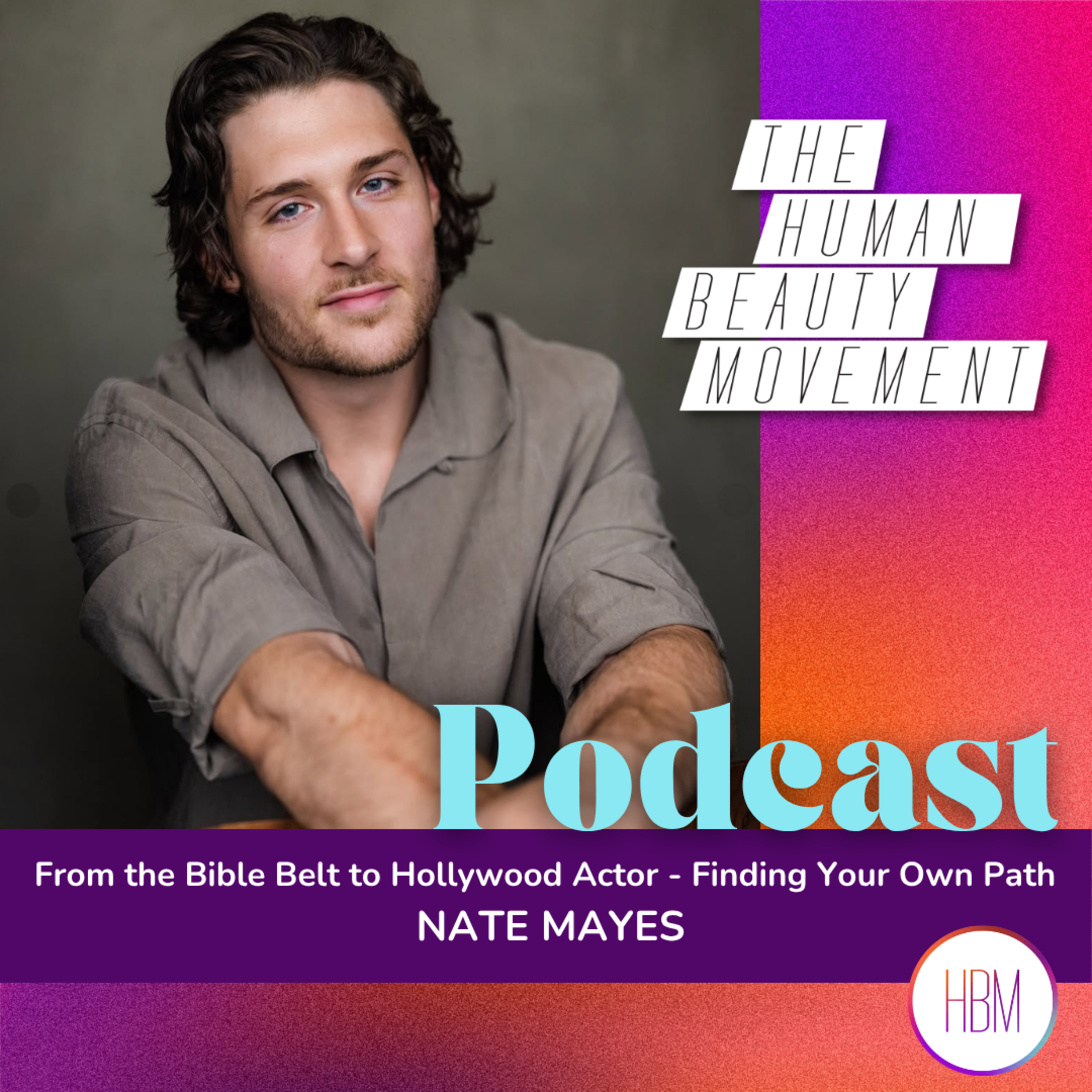


Nate Mayes is an Arkansas-born actor, artist, and fitness expert whose journey from the Bible Belt to Hollywood is a testament to the transformative power of embracing one’s whole self—body, mind, and spirit. In this episode, he shares how authentic creativity, inner grounding, and a heart-led approach can help us overcome fear, bridge cultural divides, and find joy in vulnerability. Nate’s story is a beautiful reminder that true beauty and strength are found in self-compassion, honest connection, and choosing love above all else.
This podcast episode is sponsored by*:
- Humanist Beauty - Beauty for your skin & soul, Humanist Beauty is clean, conscious, and cruelty-free. Shop here → https://humanistbeauty.com
- SupeCaptainBraveMan - Super books for super kids! SuperCaptainBraveMan picture books are sweet stories that help build disability awareness for a kinder, friendlier world. Learn more → https://supercaptainbraveman.com
*The Human Beauty Movement may earn commissions from your support
Nate's Links:
- Instagram https://www.instagram.com/natejmayes/ and https://www.instagram.com/muralsbymayes/
- Facebook https://www.facebook.com/nathanmayesart/
The Human Beauty Movement Links:
- Official Website https://thehumanbeautymovement.com/
- YouTube https://www.youtube.com/@thehumanbeautymovement
- TikTok https://www.tiktok.com/@thehumanbeautymovement
- Instagram https://www.instagram.com/thehumanbeautymovement
- Facebook https://www.facebook.com/thehumanbeautymovement
- Community https://www.facebook.com/groups/thehumanbeautymovement
- LinkedIn https://www.linkedin.com/company/the-human-beauty-movement
- X https://x.com/thehbm_official
- Pinterest https://www.pinterest.com/thehumanbeautymovement
Jennifer Norman Links:
- Lnk.Bio https://lnk.bio/iamjennnorman
- LinkedIn https://www.linkedin.com/in/jennifernorman
- Instagram https://www.instagram.com/iamjennnorman
- TikTok https://www.tiktok.com/@iamjennnorman
- YouTube https://www.youtube.com/@iamjennnorman
- Facebook https://www.facebook.com/iamjennnorman
- Pinterest https://www.pinterest.com/iamjennnorman
- X/Twitter https://twitter.com/iamjennnorman
Thank you for being a Beautiful Human.
Episode 230 - Nate Mayes (Audio)Jennifer Norman:
There's a strange thing about pursuing a creative life. For a long time, you may have very little evidence that it's going to work. No guarantee, no predictable ladder to climb, sometimes no one waiting to tell you that you've finally made it. You just have this feeling that there's something inside you that needs to be expressed, and at some point you have to decide whether that feeling is worth following. My guest today, Nate Mayes, knows something about that. Nate is an actor, writer, producer, visual artist, and fitness expert originally from Arkansas who made the leap to Los Angeles to build a life around creativity.
Jennifer Norman:
As an actor, he brings an interesting combination of grounded Southern charm and quiet intensity to his work, often gravitating toward characters with complexity, edge, and maybe just a little bit of danger. But he's steadily building his body of work through independent and short films while continuing to sharpen his craft, currently training at The Groundlings, the place where the likes of Will Ferrell, Melissa McCarthy, and Kristen Wiig got their start in comedy improv. But acting is only one dimension of Nate. He's also a painter and a muralist whose work can be found across Los Angeles with commissioned pieces created for people around the world. He's deeply committed to fitness and physical discipline, and underneath all of that is a spiritual life that informs the way he thinks about creativity, purpose, ambition, and who he wants to become.
Jennifer Norman:
What interests me most about Nate is the intersection of all of those things. Because this conversation isn't simply about becoming an actor. It's about what happens when you decide to develop the whole person, the artist, the body, the inner life, and pursue a dream without allowing the dream to become your whole identity. We're gonna talk about Hollywood, rejection, masculinity, fitness, creativity, spirituality, ambition, surrender, and what it means to keep becoming without losing yourself along the way. So let's welcome Nate Mayes to The Human Beauty Movement Podcast.
Nate Mayes:
Hi, thank you so much for having me.
Jennifer Norman:
Nate, it's so great to have you here. I want to go all the way back before Los Angeles and before acting professionally, before any of this. Who were you when you were growing up in Arkansas?
Nate Mayes:
This is gonna sound cheesy, but I was a good boy. I was a rule follower. I was very, you grew up in a very conservative Christian environment, the Bible Belt. I had the best family I could ever ask for. Thank you, God.
Jennifer Norman:
Mm-hmm.
Nate Mayes:
And yeah, I was, uh, Southern roots grow deep. I was raised hunting, fishing, very family oriented, very, very safe environment. Yeah, I had the best childhood, honestly. I, I wouldn't trade it for anything.
Jennifer Norman:
That is incredible. Now, was creativity encouraged when you were growing up, or was it something that you had to give yourself permission to pursue?
Nate Mayes:
Uh, that's another thing I'm so thankful for. I mean, I look back, I'm like, if I was a dad, I would— my kid was pursuing art, I would say pursue that, but let's also think about some other things. But I am thankful my mother was very nurturing to my art, um, and my grandma. I, yeah, they really nurtured that and it really just manifested as I grew older, which I'm thankful for.
Jennifer Norman:
Now, I heard a rumor that you were actually studying to be a preacher before you got into acting. Tell me about that.
Nate Mayes:
Yeah. OK, well, the short version is I've always wanted a stage. As you grow up learning who you are, your identity, thinking about why do I want a stage, how much of the ego is fed into that. And at the end of the day, I just really want to connect with large audiences and really— not to be cliché at all, but really show people their true divinity.
Jennifer Norman:
Mm-hmm.
Nate Mayes:
And I just have a lot of fun in front of the camera. So preaching, you know, when I was in that world, I saw that as my lane, but I worked a lot with the church and I realized just the politics in a church kind of separated me from that path. And so eventually, I've always just been a goofy thespian. And so I was like, why don't I just pursue that? Because that's what gives me, other than my traditional art form itself, like that's what gives me the most joy in life. So, and just connecting with people and telling a story is, is really really why I chose the path that I chose.
Jennifer Norman:
Wow. What did people back home think when you said, I'm moving to LA and I want to become an actor?
Nate Mayes:
So many mixed reviews. I mean, like I said, I'm so blessed that my mom always supported me in whatever I've done, but I got a lot of mixed reactions. For the most part, my friends and family have always believed in me. So even though they didn't understand at all why I wanted to pursue that, they, for the most part, supported me. But I got a lot of backlash, like, why would you go there? I feel like part of my purpose in life is to be the mediator between the far left and the far right, because I've come from both worlds and I see there's beautiful people in both sides. And most of the time when people are really talking about stigmas and the fear that they have from the Deep South and LA, most of the time they're wrong.
Jennifer Norman:
Mm-hmm.
Nate Mayes:
Just in my experience, because there's so many, just anyway, not to get too far down the rabbit hole with that. So to answer your question, yeah, there was some pushback and there was, because of that pushback, there was a lot of fear. That I faced coming over here. But once I was here and once I found my community, all that fear was erased. And I'm just so thankful that I open-minded and I'm where I am. And now I can tell the people back home, hey, it's not so bad over here. And I can tell the people here, hey, those people that you'll probably never meet are not as bad as the media may make it seem.
Jennifer Norman:
Yeah. Having a similar situation as you when I was growing up, I was growing up with a lot of dogma. And I think within my family, there was a lot of religious beliefs and opinions. frankly. And I remember when I moved to LA, there were some comments like, why would you ever move to that hellhole? It's a pit of iniquity. That, you know, and once you come here and you see that people are so beautiful and kind and you find your tribe, I think wherever you go and wherever you go, you bring yourself with you. And so you're reflecting around you what's inside of you. That's my belief.
Jennifer Norman:
And so I think that there is this point where there are people that do feel a bit siloed and they feel that it's protective. They have their—
Nate Mayes:
Mm-hmm.
Jennifer Norman:
people and their beliefs. And I too have had situations where I was very far right when I was growing up, but then I saw how manipulated that can— there's a bit of brainwashing I think that can happen all over the place that makes us feel like we are so much more different and separate from each other. And then when you open up and you're able to just reach out to another human being with a different opinion than you do and have a conversation, you realize everybody just wants love. Everybody just wants to be seen and heard and everybody wants to feel safe. And so if we can kind of get back to those basics and just find joy in life rather than antagonism, then life can be such a beautiful place if we let it. I think.
Nate Mayes:
You said that just so perfectly and adequately. It's at the end of the day, it's just having conversations.
Jennifer Norman:
Yeah.
Nate Mayes:
That's just the divide is people don't talk to each other. They just assume, or they listen to their TV screen or their No one listens to the radio anymore, but the radio or social media, if we just have conversations, it really changes the entire dynamic.
Jennifer Norman:
So getting to a little bit deeper in that point, what did you imagine Hollywood would be like? And what did you discover once you actually started to live it?
Nate Mayes:
Well, I had some introduction to Hollywood because my dad has lived here for 40 years. My biological father, long story short, he's my sperm donor. I'm a product of artificial insemination. So I met him when I was 18.
Jennifer Norman:
Mm-hmm.
Nate Mayes:
And, um, so I got to come and paint with him. He's a professional painter. Um, so I got introduced to Hollywood. So a lot of the arbitrary stigmas kind of already started falling down. I mean, some of them were true when I got here, but, um, it was like, oh, this isn't bad. And then, um, realizing you kind of have to be here. I mean, maybe not in a couple years, but you have to kind of have to be here if you wanna pursue film right now. So I just accepted that and obviously it was much different living here than visiting here.
Nate Mayes:
The hardest part was not having a community because I had such a strong community in Arkansas. So it was hard. It was really hard. But once I have established that, it just started to feel like home.
Jennifer Norman:
I'm curious what it was like going on some of your first auditions here. Tell me about any differences. I know that in Arkansas you were the How is the difference between doing theater or any kind of film work in Arkansas versus being here?
Nate Mayes:
Well, I never did film in Arkansas. I mean, I did, I produced a couple small films myself. I mean, nothing that I would show anyone, but I just did theater and normally was in school because I left for LA as soon as I graduated college. So normally the people I was auditioning for, I knew them or had heard of them.
Jennifer Norman:
Mm-hmm.
Nate Mayes:
And so, and it was theater. It was fun. I was comfortable on the stage and film was very different. It was a whole new muscle that I had to learn and still am learning and trying to perfect. We'll never perfect it. But yeah, auditioning was not fun. I'm much more confident now. It's still not fun, but I'm confident with it.
Nate Mayes:
Yeah. If that answers your question, it's very different than just the theater. It's just constant. Responding to opportunities, making sure— it's very more, I would say, detail-oriented, critical. You have to really— theater is a lot of work, but yeah, film is a totally different muscle.
Jennifer Norman:
Mm. I am so curious because there was this interesting interview with Naomi Watts, and she was talking about how when she was interviewing for Mulholland Drive, or auditioning for it, it wasn't really an audition. And she said that was the luckiest thing of her life because she says, I'm terrible. at auditions, I never audition. And she's been fortunate enough after that role to not have to audition for other roles. And she said that David Lynch was so nice, he just literally sat down and had coffee with her, and they just talked, and then she was hired.
Nate Mayes:
Must be nice.
Jennifer Norman:
I know. I was like, when does that ever happen? And I thought that that was so ironic. Like, there's some people that just have a really lucky time of it. Sofia Vergara was another one. She said she would go for this— her agent would send her for an audition of a role, for a singer. And she's like, I don't know how to sing. And she never took an acting lesson in her life.
Nate Mayes:
Wow.
Jennifer Norman:
Which is just amazing to me. But she said, I didn't know how to sing. I just went up there and I started trying to carry a tune. And she got hired for the role.
Nate Mayes:
Yeah, the industry has changed so much. It changes every day. So those stories, I envy those people. But I have to say, my most successful roles, my favorite films and projects that I've been on haven't really been from auditioning. They have been from just collaborating with people that I already knew. So yeah, I can't relate to that. Maybe one day.
Jennifer Norman:
Maybe one day. Yeah.
Nate Mayes:
Yeah. It's a lot of auditioning. Lots of auditioning.
Jennifer Norman:
Yeah. I find that it's interesting. You were the good boy growing up in Arkansas, and now you lean towards more edgy, maybe darker roles. Why do you think that is?
Nate Mayes:
Oh, that's funny. That's a good question. Yeah, I am very drawn to I mean, darker roles is an open— you can go a lot of ways with that.
Jennifer Norman:
Yeah.
Nate Mayes:
But I am a character actor. I guess the easiest way I can answer this, I'm a character actor and I love to experience the lenses through a character that is so innately different than who I am. It enables me to learn this new type of empathy for other people and other groups that I would maybe not have the opportunity to talk to.
Jennifer Norman:
Mm-hmm.
Nate Mayes:
And at the end of the day, that's— I receive so much joy from playing characters that are so different from me. I actually really struggle with playing characters that are more aligned with me, Nate. So, yeah, I think that's really what it is. It's not necessarily that I love playing darker characters. It's just characters that I don't personally have experience murdering anyone or being the bad guy. So, I also grew up on Westerns. So, playing the outlaw is just really fun. It's fun and it's intriguing.
Nate Mayes:
And yeah, I like playing people that are far outside of me.
Jennifer Norman:
Do you think that it's because it is a bit of a challenge and it does help you to get better at your craft that you are really stretching into the acting rather than just playing yourself?
Nate Mayes:
Well, it is always a challenge. There's always work to do. But honestly, I find it much easier to play a character that maybe has a different accent, like I played a drag queen not too long ago.
Jennifer Norman:
Ooh.
Nate Mayes:
And that is so far from how I grew up, how my life is. But to be honest, it was easier for me than playing like the Southern cowboy because I just had to dive into something that was almost like I'm losing myself. I mean, I'm taking myself with me, but I'm getting lost in this totally different avenue in life. It's almost like It's almost like a psychedelic trip, I could say. So not to get too in the weeds, but I don't know really how to explain that. But I just really— I'm more drawn to characters outside of myself.
Jennifer Norman:
That's very, very cool. Do you think that there is this part of building an acting career that nobody really sees?
Nate Mayes:
Oh, yeah. I'd say 99% of it.
Jennifer Norman:
Yeah?
Nate Mayes:
I mean, you know, you have to go to class, you have to audition, you have to network. But I mean, I'd say on face value, that's what people see. And I mean, I obviously have a lot of friends from back home that aren't in this world at all. So when I talk to them, it's like just so foreign what I go through, the events that I go to just to shake hands with people. So yeah, there's a lot that's misunderstood. And it's also just— it's changing on a daily basis, the industry. So yeah, there's so many things that I've learned just in the last few years that understanding the importance of building a network, the lucky moments. I don't think anything is luck.
Nate Mayes:
I think everything is driven around purpose and intent. There's no coincidence. That's just me. But yeah, I've learned knowing yourself and being open leads to opportunities. And there's a lot of weird opportunities that I've had that have led me to really cool places that I never would've thought would have.
Jennifer Norman:
Now, you do have a very grounded nature about you. I know that you said that you're in your audition room right now as we're recording this, but it's also your meditation room. Do you think that helps you as you are facing this, what could be considered a pretty tough industry where people get chewed up and spit out, where rejection is part of the process? I think that a lot of people just have a general fear of rejection, but do you think that that helps you as far as being able to handle it and know that it's not really a reflection of your own self-worth? And And that it's just part of the game, part of the process.
Nate Mayes:
Yeah. I place my value in me and God, the universe.
Jennifer Norman:
Hmm.
Nate Mayes:
Not in anything else that is 3-dimensional. Hmm. And thank goodness I do that. I haven't always done that. So I had to learn that so many things are temporary, but the faith that you have in yourself and the just who you are on a cellular level can really help you navigate through this industry because this industry is, uh, special. There's a lot of good things that happen, but it's also very nasty. It can be. And there's a lot of different people and things that will try to tell you what you are.
Nate Mayes:
And if you don't know who you are, then that can be really scary and you're in a very vulnerable place. So yeah, it's tricky, this culture. I think it's especially, you know, caught up in the influencer and social media.
Jennifer Norman:
Yeah.
Nate Mayes:
Uh, world. And yeah, I'm not trying to give advice, but I guess I'm just saying for me, the, you mentioned groundedness. I appreciate that comment. Yeah, I try to stay grounded. Because I realized that when I'm not, I might make an impulsive decision or I experience a lot more stress. Yeah.
Jennifer Norman:
So there's been some examples of when you felt like, okay, you like fell into the trap of doing something that you didn't really feel was aligned.
Nate Mayes:
For sure. I mean, I've had to take a lot of beats when I've been given several opportunities and then you realize those opportunities are not all that they said they were at first. Yeah. I'll give an example. You think you're doing a, a very grounded drama that's gonna give you some, some really good views and content, and then you realize it's basically pornography. And you have to, a lot of, there's so much of that. And so I've had to take a beat.
Jennifer Norman:
Oh, wow.
Nate Mayes:
And lock myself in a room and really just say, is this for me or is this against me?
Jennifer Norman:
Oh yeah.
Nate Mayes:
And that, that particular was against me. And when you get amped up in the energy and the opportunity, it's like, oh, this is it. And then it's in disguise as something that can lead your career somewhere where you never wanted it to go.
Jennifer Norman:
Wow.
Nate Mayes:
Yeah, it's, yeah. So to answer your question about the rejection, yeah, seeking faith in who you are and just know, having that, I guess, that faith of, hey, we're gonna get there. Might take longer than we would like, but we're going to get there. The rejection is— it's always hard, but I guess it's a lot easier when you're not constantly seeking success from other people.
Jennifer Norman:
Yeah, yeah, knowing that it's just intrinsic and that the roles— it's nothing personal. And that's the hard part of it because you're putting your heart and your soul, your body on the line and your face. And a lot of it has to do with appearance or how attractive, quote unquote, you might be to the audience in some roles. Yeah. Sometimes they get conflated and it becomes confusing if you don't have that center. I also did hear a part of an interview where you said one of your filters is, would my mom be able to watch this? And I thought that that was kind of cute. So that kind of ixnays pornography right then and there, I suppose.
Nate Mayes:
Right. I mean, there's definitely some roles where I would be okay if she didn't watch it, but at the end of the day, like, I wouldn't— my life wouldn't be over if she did. So yeah, I do try to keep that in mind. Like, there's some roles like, okay, I'm going to do this. I'm just not going to tell my mom about it. But if she came across it, it would not be the end of the world.
Jennifer Norman:
So diving in a little bit deeper on this, because talk about masculinity, you have played a drag queen. I think that that is incredibly wonderful that you get in touch with a feminine or a very unique, different side of you. Image, Hollywood, your body fitness, you do do Fitness training. And I think that that's also a very unique and interesting discipline that does go quite well with using your body and having some sort of a control and being able to, I guess it would be, know when to push yourself to a place where you know it's going to give you strength versus pushing yourself to a point of non-recovery and too much. Do you think that that has helped you in your life in general of, of being able to find what real strength is?
Nate Mayes:
Yeah, absolutely. The body mimics what the mental takes on, and I've been in a lot of very rigorous sports and bodybuilding to where I've realized that I can push myself a lot more than I thought would be possible. So definitely, I think that could be really good for a lot of people just going through the strenuous exercising and really treating your body like it's a temple. So yeah, I'm very thankful for the path that, that I've had with, with fitness for sure.
Jennifer Norman:
Do you think that the idea of vulnerability and masculinity are mutually exclusive? Or do you think that they can coexist?
Nate Mayes:
I mean, okay, in my opinion, the idea of masculinity is very skewed and misunderstood in our culture, you know, the whole idea of toxic masculinity, there is that, but that's separate from, I think, true masculinity, the— I think of masculinity and femininity as these 2 spirits that coexist. And when we have the balance of the 2, life is just So much better. And so I think what we're seeing— try not to go down the rabbit hole. I think—
Jennifer Norman:
Please do. This is a long-form podcast. You can rabbit hole all you want.
Nate Mayes:
Well, I just, I feel like we're experiencing in the culture right now, like almost the return of the feminine. We've had this generations of, of a lot of control, a lot of religion, and a lot of just traditional aspects that come from religion, meaning like the man is in control of the household and there's a lot of— I'm not saying it's a bad thing. There's a lot of views you can take from that. But I think we are seeing a much more feminine approach in our culture. And I don't think that either one of them is better than the other. I just think balance is the best that we can ask for. So yeah, I mean, coming to a more— just coming to LA and getting more in touch with my feminine spirit, and it has definitely made me a better actor and a better human being. I grew up with just a mom, so I always had that feminine energy with me.
Nate Mayes:
And so it's been a really interesting life for me to navigate those 2 spirits, those 2 energies. So I'm thankful for both, and I'm still navigating what they both mean to me, what I can pull out of me for different characters. Obviously, playing a drag queen, it's a lot more feminine than playing a cowboy.
Jennifer Norman:
So how would you describe divine masculinity versus— obviously people are familiar with toxic masculinity, so we don't have to go there, but what is the divine masculine to you?
Nate Mayes:
That's a good question. I think I see the divine masculine as protection, as the fight source. People talk about fight or flight, and not saying that feminine being can also do those things, but I see it more as this, just this, I guess this fortress of protection and groundedness. I see it as more like very, I experience a lot of the masculine feeling when I'm camping and I'm out in nature. Like I just feel very connected to the earth, if that makes sense. And so, yeah. I also just have a very, I think everyone has their own like independent idea of what the masculine is. I think the more in touch we are spiritually, the made, the more authentic it is.
Nate Mayes:
But I have a grandfather and I have cousins. I have family members that have, have displayed the masculine energy as very positive.
Jennifer Norman:
Oh.
Nate Mayes:
And just seeing the good in them and the aspects of just being the man, being the man, being the protector, being the, being respectful to the women that they have in their lives. I see them as just great mentors and very masculine human beings. You know, a lot of them all served in the military too. And so you just have that abundance of like, I will take a bullet for you. That's what I think when I think of the masculine. Hope that made sense.
Jennifer Norman:
Oh, it absolutely did. That was a beautiful picture that you've just painted. I love that. And speaking of painting, I'm going to switch gears and talk about that other aspect of your creative side. I think that there's something fascinating about creating murals because you make something personal and then you leave it in a public space where anybody can experience it or interpret it. I would love to hear about your experience having started to do paintings with your dad. How beautiful. And now you're doing other works.
Jennifer Norman:
Are these artistic instincts, do you have, or do you feel that they use a different part of your creativity? And does it unlock something in you when you're painting?
Nate Mayes:
Well, not to get off on a tangent with the feminine and masculine, but I do feel that embracing the feminine energy when I'm painting is very much so it's very fluid. It's very loose. It's very just, I feel kind of like I'm in a faraway place when I'm painting. So, so yeah. What was your question? I'm sorry.
Jennifer Norman:
Yeah. Yeah. No, that is actually a beautiful way to express it. I was wondering because with acting, you're using a different, you're using a certain kind of creative muscle and painting. I think that you just expressed it. It's like, yeah, you're in, you're almost in a different kind of flow.
Nate Mayes:
I explain it to people, well, any type of art form, even acting, there's obviously a lot of differences, but there is a flow state that any type of artist talks about, especially writers and painters. You get into this flow state and it's really, really nice place to be if you've ever experienced it. It's just, you're just doing what you love and you're not really thinking, you're not being like very clinical. So yeah.
Jennifer Norman:
Hmm.
Nate Mayes:
I love painting. I love getting lost. It's a really nice grounding experience for me.
Jennifer Norman:
That's amazing. And doing things in large proportion versus just on a canvas.
Nate Mayes:
Yeah, I gotta go big.
Jennifer Norman:
Is that a big meaning for you? You gotta go big.
Nate Mayes:
Well, it's also, it's, uh, painters will understand this. Um, if you're not a painter, you won't, but it's so much easier to go big with most art forms. And so I do a lot of portraits, large-scale portraits, and there's a lot of kind of composition and math that goes into that. And so when you have a bigger canvas or a bigger wall, it's just so much easier to get the detail you want. I do realism. So yeah, I suggest, you know, it's nice to have 100 people see a 20 by 20 mural versus a little, little canvas personally.
Jennifer Norman:
Where do you think that intuition fits in with regard to your creative aspects?
Nate Mayes:
I would hope to think that intuition fits into everything, especially my creative endeavors. I think when I'm more connected to my intuition, there's a lot of rewards from that. So it's hard to answer because I think I'm the best version of myself when I'm really paying attention to my intuition. When I'm not, I'm very disconnected and I don't think I have the same opportunity.
Jennifer Norman:
Have you been able to recognize what the difference is between intuition and fear in yourself to say, oh, I shouldn't do this, or, oh, this is telling me that I should do this?
Nate Mayes:
Maybe most of the time. Yeah. I think you have to train it. You have to be really in touch. I guess your audience would understand this. Um, it's, have you ever read The Untethered Soul?
Jennifer Norman:
Yeah.
Nate Mayes:
Yeah. So I think of it that way, like deciphering that voice inside your head that I'll just call it fear versus the total opposite of that, which is your intuition and deciphering between the two. So I don't know. I feel like it, maybe it's a constant battle because anxiety is good. Stress is good. We have it for a reason. But not letting that overcome us and just allowing the spirit within you to really override that. If I'm in a really close space, grounded environment, surrounded by good people, that's, I think it's very easy for me to access.
Nate Mayes:
If I'm not, then it's a little harder to hear.
Jennifer Norman:
Yeah, those are beautiful ways to think about it because there is a disconnection and a losing of yourself. I think if you follow that path that says, oh, well, this seems like a good choice, like from a logical perspective or what other people might think around, you know, the rational. And sometimes the intuition just speaks a bit more quietly. And that's why sometimes it's harder to hear. But if you're able to have those quiet moments and think and just meditate as you've created a practice to do and to start your day with intention, it becomes clearer and clearer as you live your life. And so it's a good practice to begin. I'm curious now that you're here and you're doing these wonderful things, you're studying in comedic improv with The Groundlings. What does making it mean to you now?
Nate Mayes:
Oh man, just being able to still tell stories that I'm really passionate about and have a comfortable living at the end of the day. Yeah, I mean, I think anyone is a fool to say that fame is not appealing at all, but I have seen what fame is at, at the large scale, and it's not as appealing to me than it was when I was younger. But at the end of the day, just having absolute freedom to wake up in the morning and pursue a creative life and get paid for it, have a comfortable lifestyle. That's it for me. I balance a lot of different jobs right now. Some of 'em I'm passionate about, some of 'em I'm not. Some of 'em just, you know, helps me pay bills. And so I—
Jennifer Norman:
Yeah.
Nate Mayes:
Am excited for the day where I can only do, I only have to do what, what I'm passionate and just really leading with the heart. I'm very excited for that day.
Jennifer Norman:
That's so great. And I think that in the pursuit of it all, a lot of times we forget that time is the ultimate currency. I mean, beyond money, having more money is great, but having the time to really spend in the way that you wish to and being able to take care of other things. I mean, I think that that is a real great recipe for happiness, joy, a reduced amount of stress in your life, and just living with that kind of balance where you just really get to design the life that you want to live.
Nate Mayes:
Absolutely. I mean, there's 2 different I feel like my mom always said, don't wait around, do what you love no matter what. And then I've had bosses tell me, make as much money as possible, do something that you don't love so it'll free you up and you can have a longer retirement. And I'm so glad I listened to my mom because I'm— because sure, I could, maybe I'll be, I would be sitting on a bucket of cash in 10, 20 years if I went the other route. But like, you're right, like time is the only currency. We're not guaranteed tomorrow. Even if we don't have the mansion that we want right now, like it's like pursuing a life with passion and intention is I'm so thankful for.
Jennifer Norman:
Yeah. Well, Nate, this has been such a lovely conversation. At the end of each of my episodes, I ask all of my guests the same 3 common questions. My first to you is, what do you think makes you beautiful?
Nate Mayes:
I'm going to say leading with authenticity. I do my best.
Jennifer Norman:
Nice answer. What does it mean to be human?
Nate Mayes:
Oh my goodness. Connecting to the source rather than the world. Personally, yeah. Connecting to the divine source, who you are, your creator, whatever that means to you, I think helps you realize that we're all connected at the end of the day. So going beyond the what's here in front of me, if that makes sense. Yeah.
Jennifer Norman:
Beautiful. And my last question, what is one truth that you live by if you had to pick just one?
Nate Mayes:
One truth that I live by, always choose love.
Jennifer Norman:
Yeah.
Nate Mayes:
No matter what. And you might have different interpretations of love, but I think at the end of the day, love at its core, we come from love, we return to love. That's always gonna lead you to make the right decisions, I hope.
Jennifer Norman:
I love that. Thank you so much. I am so excited to see where your creativity takes you and what you continue to discover along the way. Thank you so much for being here.
Nate Mayes:
Thank you. This has been such a joy. Thank you, Jennifer.
Jennifer Norman:
And to everyone listening, thank you for spending time with us. If you enjoyed this conversation, do subscribe, like, and comment. It helps this humble podcast grow and touch more lives. I'm Jennifer Norman, and this is The Human Beauty Movement Podcast. I'll see you in the next episode.
Jennifer Norman:
Thank you for listening to the Human Beauty Movement Podcast. Be sure to follow, rate, and review us wherever you stream podcasts. The Human Beauty Movement is a community-based platform that cultivates the beauty of humankind. Check out our workshops, find us on social media, and share our inspiration with all the beautiful humans in your life. Learn more at thehumanbeautymovement.com. Thank you so much for being a beautiful human.


