
How to Unlearn Bias & Rewire Your Brain | Anu Gupta, Ep 210
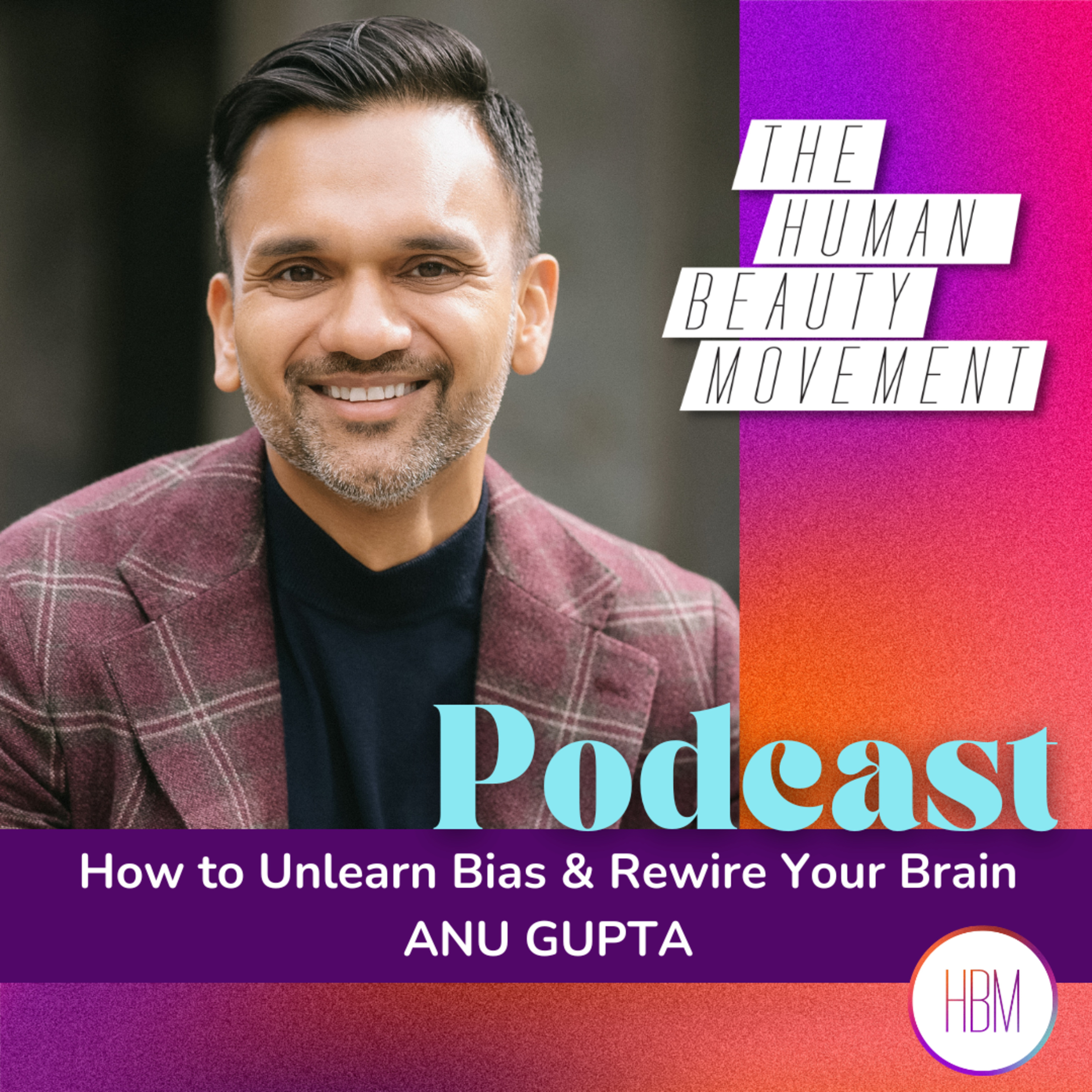


In this deeply personal and enlightening episode, The Human Beauty Movement welcomes Anu Gupta to explore the roots of bias, how these learned patterns shape our sense of self, and how compassion and mindfulness can help us unlearn and heal. Anu shares his journey as a gay immigrant of color, detailing his struggles with internalized bias and the transformative power of self-acceptance and connection. The conversation offers practical tools—like the PRISM framework—for breaking bias within ourselves and invites us all to reimagine a more unified, compassionate humanity.
This podcast episode is sponsored by*:
- Humanist Beauty - Beauty for your skin & soul, Humanist Beauty is clean, conscious, and cruelty-free. Learn more here → https://humanistbeauty.com
- Headspace - Headspace has one mission: to improve the health and happiness of the world through meditation, sleep, stress reduction, and mindfulness. Learn more here → https://headspace.pxf.io/thehbm
- Organic India - Organic India is a Certified B Corp that offers organic teas & supplements formulated by traditional wisdom and modern science. They embrace organic regenerative agriculture, ethical fair trade partnerships & beneficial, inclusive social change. Learn more here → https://organicindiausa.sjv.io/thehbm
- Seed Health - Seed Health is a microbial sciences company pioneering applications of microbes to improve human and planetary health. Learn more here → https://seedhealthinc.pxf.io/thehbm
*The Human Beauty Movement may earn commissions from your support
Anu's Links:
- Website https://www.bemorewithanu.com/
- Instagram https://www.instagram.com/bemorewithanu/
- Facebook https://www.facebook.com/bemorewithanu/
- LinkedIn https://www.linkedin.com/in/anuguptany/
- Heal Divides, Restore Connection Retreat, Jun 5–7, 2026 https://www.eomega.org/workshops/heal-divides-restore-connection
The Human Beauty Movement Links:
- Official Website https://thehumanbeautymovement.com
- YouTube https://www.youtube.com/@thehumanbeautymovement
- TikTok https://www.tiktok.com/@thehumanbeautymovement
- Instagram https://www.instagram.com/thehumanbeautymovement
- Facebook https://www.facebook.com/thehumanbeautymovement
- Community https://www.facebook.com/groups/thehumanbeautymovement
- X https://x.com/TheHBM_Official
- Pinterest https://www.pinterest.com/thehumanbeautymovement
- LinkedIn https://www.linkedin.com/company/the-human-beauty-movement
Jennifer Norman Links:
- Lnk.Bio https://lnk.bio/iamjennnorman
- LinkedIn https://www.linkedin.com/in/jennifernorman
- Instagram https://www.instagram.com/iamjennnorman
- TikTok https://www.tiktok.com/@iamjennnorman
- YouTube https://www.youtube.com/@iamjennnorman
- Facebook https://www.facebook.com/iamjennnorman
- Pinterest https://www.pinterest.com/iamjennnorman
- X https://x.com/iamjennnorman
Thank you for being a Beautiful Human.
Jennifer Norman:
What if the biases shaping your thoughts, your decisions, even your sense of self weren't actually yours? What if they were learned patterns quietly programmed into your brain? And more importantly, what if you could unlearn them? Today's conversation isn't just about bias. It is about liberation. It's about reclaiming your humanity in a world that is becoming more and more divided. My guest today is Anu Gupta, an award winning speaker, lawyer, scientist, meditation expert and founder of Be More with Anu, an organization dedicated to breaking bias and healing identity based divisions at scale. Anu's work has reached over 300 organizations, trained more than 100,000 professionals, and impacted over 30 million lives globally. He's the author of the best selling book Breaking Bias with a foreword by his Holiness the Dalai Lama. But Anu's work isn't just intellectual, it is deeply personal. As a gay immigrant of color, Anu faced lifelong experiences with racism, homophobia and Islamophobia.
Jennifer Norman:
Experiences that led him to a breaking point where he almost ended his life. But what brought him back was this profound realization. Bias is learned and therefore it can be unlearned. That realization became a movement in today's episode. You will learn how biases live in the brain and how to rewire a powerful framework to interrupt prejudice in real time. What soul force looks like in a hyper polarized, AI driven world. How to lead with compassion without burning out. And why healing ourselves may be the most radical act of social change.
Jennifer Norman:
This is a conversation that invites you to see yourself and each other through a radically more human lens. So let's get ready for this beautifully human conversation. Hi there, Anu. Welcome to the show.
Anu Gupta:
Thanks so much, Jennifer. It's an honor to be here with you.
Jennifer Norman:
It is so great to have this time together where we can talk about so many important things. I had the privilege of enrolling in your DEI work a while back. I watched your TED talk on Breaking Bias and I will say that I have just felt so attached and aligned with your work. And so I'm so pleased to be able to share it with the audience today, especially since over the last couple of years, shall I say, things have shifted and we will certainly get into all of that. But so to start off, I just want to let you know that I am really fascinated by the work because it is scientific and it is very human. And so I want to start with you. I want to start with your story about what brought you to this work and, you know, how it has been impacting you to this day.
Anu Gupta:
Yeah, well, thanks so much for having me here. And I think for me, the work of breaking bias really chose me. It's not something I ever wanted to do. My family immigrated to the United States when I was 10 years old. Like a lot of Asian parents, they wanted me to become a lawyer or a doctor or something along those lines. And I actually was on that path until I confronted a lot of biases from the external world for no other reason than my being right. Things that I couldn't change. My skin color, my appearance, my sexuality.
Anu Gupta:
And I got called a lot of names, particularly in light of 9, 11. I grew up in New York City, so I became fascinated with this idea of, why are people so cruel to one another for no other reason than their being? You know, we can't change our gender, we can't change our body parts, we can't change who we feel attracted to, we can't change our skin color. And that was a journey that I was very quietly pursuing on my own through, again, academic studies, because I'm a big nerd. Through college and after college, I lived in South Korea for some time. I lived in Myanmar and pursued a whole master's in international development, wanting to really understand the institutional nature of things. And after that, work took me to law school. But throughout this time, there was this quiet voice in the head that kept on saying that you don't belong. There's something wrong with you, that kept on getting validated by the external environment.
Anu Gupta:
Like, every time I would share any personal experiences with bias, with racism, with discrimination, I'd be met with awkward silences or that I'm too emotional or why can't I take a joke to the point that, you know, when I was about to start my second year of law school, I was like, maybe everyone around me is right. Maybe I am the problem. And that's when I found myself on the ledge of my 18th row window, and I actually jumped. And what happened after that is still a mystery to me, but it really brought me to this path of breaking bias, because instead of falling forward in the midtown Manhattan traffic below me, I fell back in my apartment. And what happened right after that is even more miraculous because I had just met another Asian American queer person a week prior, and for some reason, I felt really close to her, and I felt like I could share my story with her. And I called her, and she lived maybe like two or three miles away from where I am, but she happened to be walking on my block that very instant. Within a few minutes, she came up to my apartment. We spent the next five or six hours together.
Anu Gupta:
And the next morning, I went to the NYU Counseling center, and it was that moment that really began my Breaking Bias journey. I began. Well, how did I come to that breaking point where I almost ended my life? And what are these ideas that I am beginning to? Not just beginnings that I believe about myself. Where do they come from? So it was that interrogation that really led me to understanding the nature of bias, how it operates not just in the psyche, but in our bodies, in our emotions, and then how do we undo them? So it's really, like, part of my life journey.
Jennifer Norman:
Wow. Oh, my gosh. Thank you for sharing that deeply personal story. And as somebody who is also of Asian descent, my story is different than yours, but I feel like there are similarities in coming to a new place. My audience knows that I'm adopted, and I have a white family. I also have other siblings from another territory in Asia. But there is something that goes deeply unspoken, and it's something that it's hard to put into words when you're growing up and when you're feeling these things, especially when you feel like you can't talk to your parents about it because of maybe cultural differences or shame or feeling like there's expectations and you should be grateful for your life. I know that for me, there was a lot of unconscious bias in my family that I would love to unpack with you, too, to the point where I remember I had gotten into an argument as a teen with my mother because I wanted to cut my hair.
Jennifer Norman:
And she was very controlling. And I think this is why I got into the beauty industry, because I wanted to have control over the way that I look. But my mom was like, you are not cutting your hair. I went and I cut my hair, and I came back, and it was like this act of defiance, I suppose. And it was for a modeling job. So I was like, they wanted to cut my hair. So I come home, my hair is cut.
Jennifer Norman:
And she said, you look ugly. You look like any other Chinese girl now. And so it was one of those things that took me aback, because this is the mother who adopted me, who I never would have expect it would say something like that. But all of a sudden, it was something that I was like, wow. I never would have expected somebody who would adopt somebody else would then come back and say something like that because of some sort of an unconscious bias and a feel of just a loss of control. And in your case, you had somebody who was a friend who knew you and who shared some commonality with you that could essentially not necessarily talk you off the ledge, but talk you after the ledge. In some places, people are lucky enough to have people that can talk them off the ledge. But yeah, I would love to definitely dive into this a little bit further because it goes so, so deep. And I know that there are so many stories about how this really does impact people to the point you're so successful, you've got three degrees yet this is the thing that almost ends you and this is the thing that also causes you to realize what your new life's work is going to be.
Jennifer Norman:
So, yeah, yeah, tell us what you know about bias. Tell us what is the first of all, also the difference between bias and prejudice?
Anu Gupta:
Yeah, well, first of all, thank you for sharing your story and it's like an honor for me to bear witness to it because these are the stories that are living in our bodies. Who's listening, who's watching? And it's so important to express them. And the way you express it too, there's no anger, you're just speaking your truth, right? That's what this invitation is for us to really purge out all of this venom that we've taken it all of these poisons from our. It's not to shame, blame or guilt any who causes or perpetrates violence or bias, but it's technology that, oh, that is not the truth of who we are beings. So for me, I think when I think about bias, your example, case in point is ever since I was young and I was attracted to these movements of inclusion and human rights and justice, there was always a way that we approached this problem which was like, oh, the root cause of all the challenges is racism or sexism. We are here. Misogyny, which I understand, but how can I explain that to my six year old niece? It's so heady and it's so cerebral and it's so systemic and structural. But here we are, you and I, living our human lives in our little bubbles, right, Just trying to make it through the day and yet we're experiencing it.
Anu Gupta:
So what is that thing? And for me, this is where I went to the science, right? Whenever I would ask people, how do you define racism, how do you define sexism? It would be very, very long definitions about power and privilege and this and that. And I'm like, wait, no, this is like, yes, it has a place in society, in academic circles, but how do we really make this a movement for the people? And that's when the research on implicit bias or unconscious bias really caught my eye. And scientists, what began at Harvard at the implicit association test had since for 40 years had collected so much research and so much evidence showing that human beings have a way of associating different concepts. And basically at a subtle level, every experience we have through our senses, our sense of sight, our sense of hearing, our sense of taste, touch, you name it. And even our sense of imagination has what they call an emotional balance or like a feeling tone attached to it. Pleasant, unpleasant, or neutral.
Anu Gupta:
We call in everyday vernacular, oh, how do you feel? Good. Bad. Okay, that's how it is, right? So if you think about a cheeseburger, someone was like, oh, my God, delicious. I really want one. Others are like, yeah, I'm vegan. I don't. You know, I'll pass. Not so good. Same thing with music, same thing with whole host of experiences that we have, but also connects to people.
Anu Gupta:
And the interesting thing on the research is that they began to show that a majority of Americans have an easier time associating positive attributes with dominant identities. Basically, men over women, white people, people, white people over Asian people, thin people over fat people, you name it, right? And the interesting they found thing that they found that this is not only about the dominant identity, it's also all identities. So large number of black people have the same association. A large number of Asian people have the same association. A large number of fat people have the same association. So even some of the most progressive activists, they're like, oh, my gosh, I still associate black with being bad and white would be good. What's that about? And that's where I was like, well, this is the key first to understanding, well, what is bias? And the more I research from the studies, you know, this is how it comes out as doctors treating their patients differently, teachers treating their students differently, police officers seeing everyday people on the streets differently. So what is nation? That's happening in the mind, and that's what bias is.
Anu Gupta:
And there are two forms of biases. There are conscious biases and there are unconscious biases. So conscious biases are learned false beliefs. So false beliefs about women that they're better homemakers than CEOs, or false beliefs about black people not being good enough or Asian people being good at math. These are false beliefs, but a lot of people have them. But that's conscious. But then there are learned habits of thoughts, which you said learned patterns. Right, Patterns.
Anu Gupta:
When we think of CEO, we think of a certain kind of person. When thinking of the teacher, we think of a certain kind of person. So these are habits of thoughts, these associations that become tied to one another particular, particularly around our appearance and our identity. And these either false beliefs or habits of thoughts distort how we perceive, reason, remember and make decisions. And for me, that's what was like, aha, I found the bullet. This is what's causing us so much pain in our society. And the beauty is that because of neuroplasticity, we know that anything we've learned, we can also unlearn.
Jennifer Norman:
Yeah.
Anu Gupta:
And that has been my journey. And prior to starting this work, I was also a deep meditation practitioner, I still am, and really moved into contemplative sciences. And they started showing that we could practice these mindfulness and compassion based tools can actually help us measurably reduce our biases. So my work was then pretty straightforward. My passion for social change, for equity, for inclusion, combined with meditation and really bringing them together so we can break bias and really live in a world where we each fully belong just as we are. We don't have to change anything about ourselves. We can celebrate ourselves and others. It's not about being better or worse than it's about being.
Jennifer Norman:
Wow, that is so incredible how you were able to describe that. I think when people think of bias, they often think of other people, of that person, and something that's harder for us to really call out unto ourselves. But I think that there had been this moment in time, probably over the past six years, where people have become more contemplative about, well, what are these biases? And how can I learn to move past that? We saw a lot of initiatives in corporations and in organizations and online about how we could learn to have more of a diversity and inclusive lens. There were definitely pros and cons to some of those, and unfortunately now a lot of that is being rolled back and backpedaled. I would love to know, first of all, how can we continue to ensure that we are moving in a way that helps us all to come together instead of separating and fragmenting in this world where we do embrace individualism and this almost like uber form of democracy where everybody feels that they matter and they deserve a seat at the table, but that causes us to push our own interests forward without necessarily being able to invite others to sit along with us. How do you respond to that?
Anu Gupta:
It's a beautiful question. I think for me, what's happening right now is just momentary because this work of breaking bias, building bridges, becoming peacemakers, bridge builders, this is the work of our century. You know, I really feel like this is a continuation of the work our ancestors did. Whether it's the civil rights movement or the independence movements around the world, or the women's, you know, this is the continuation of that. And as a result, we're at a place where we're in conflict and there's some that's going on and there are reasons for it. Right. But I think for me is to remember the big picture. Where we were 100 years ago, 50 years ago, where we are now.
Anu Gupta:
And then the steps, steps we can take right now to imagine a brighter future, regardless of how dismal the outside world may seem. So what do we need to do? How do we get there? Well, I think for me, one of the things that's really important is the reason why what's happening in the world right now has three reasons. One is there's a lot of misinformation. So I think we have to really correct the misinformation. And yeah, of course, the algorithms out there are spreading even more fake news and misinformation, but we can't control that. Unless actually, if you're a listener and you control the algorithms, please listen deeply. You can do a lot, but most of us, right, we don't control the algorithms, but we can do. What we can do is actually correct misinformation for ourselves and the people that we can influence and have impact over, like our children, our families, our co workers, our community members.
Anu Gupta:
And the way to do that, I think for me is the simplest way that the Dalai Lama really described a framework that I use in my book that ultimately all of us as human beings have a primary identity, which is that we're human beings. We're 99.9% genetically identical. The people that are put in different racial categories are oftentimes have more genetic commonalities than people in same categories. That's the mystery of our existence. And also it says that all these identities are fabricated. They were created, they're ideas. So that's really important for us to remember. So all the ways we label our bodies as our secondary identity.
Anu Gupta:
So correcting that information, understanding that race as a concept that affects and hurts so many people, makes us feel divided, is less than 250 years old. I mean, in 10,000 years of history, 250 years is a blip. So we can actually transform it. Now it's up to us to really come together and be like creative on how we're going to transform it. So that's really important. And I share a lot of those stories of how a bunch of skull collectors created this idea in the book. And that's really important to know. So really correcting misinformation, also bridging the information gap.
Anu Gupta:
So a lot of people may not have this information, but they just don't know any better. Like, a lot of us weren't taught the basics of identity until we take it in from our surroundings, from the news we watch, or our social media algorithms. So this is where we have to really bridge the information gap. And the third and most important is bridging the empathy gap. There's a massive empathy gap in our society right now. And for me, bridging that empathy gap really begins with ourselves. So the one type of bias that people often forget about is internalized bias. The way we treat ourselves.
Anu Gupta:
The inner critic, the voice in our head that keeps us putting ourselves down. Our being, our temperament, our appearance, our looks, our weight, you name, our skin color, our hair texture, you name it. Right. Our profession, our income generation, you. So these are the things that we can really befriend. And this is where the tools really help us. And for me, this movement really is a movement of the heart. It's really heart from feeling hatred, from feeling this need to dominate or being better than to actually just being.
Anu Gupta:
What's in the yoga tradition, it's known as contentment, Santosha, being content. And when we come from that place of having our cup full, we can actually distribute what comes out to others. For me, that's really how we're gonna face all the, you know, for lack of a better word, like all of the hate and all of the poison that's being spread around. But I think we are being called to become the medicine, being the anti. I feel like the Human Beauty Podcast is part of that antidote. It's allowing people to imagine. It's allowing people to feel connected to themselves and one another. It's building, and that's really the work of our time.
Jennifer Norman:
Yeah. Oh, you said so many beautiful things that I just want to reflect on for a moment, and that is that, first off, I think that when we're young, we do learn these biases. These are things that we don't really necessarily believe about ourselves. Until somebody says something, something happens, we get these cues. Even if somebody doesn't say anything, they might look at us or shy away from us, or there might be something that just gets learned, and then we recognize how that feels. And somatically, as you were describing, that gets into your body as emotion, and it stores up. And then we start believing these things about ourselves, whether we like it or not. And most often not, because we do develop these inner critics that say, oh, I'm ugly, I don't belong, I'm stupid...
Jennifer Norman:
Like all of these horrible, horrible things that we have as self talk about ourselves which cause us to feel like we don't belong. And so it's almost like this whole vicious cycle about just not feeling well about ourselves and then creating more divides with others, which I think we tend to be a world of very unhealed people. So the greatest act that we can do is become self aware and learn to love ourselves first and then. Yeah, but that is very deep work. It's that work that you do. It's really getting into all of those nooks and crannies of mind, body and soul holistically and being able to excavate it and release it. And you know, not necessarily that it doesn't exist. We're not putting our heads in the sand.
Jennifer Norman:
It's that we can coexist beautifully with ourselves as well as with our society at large. And you know, to your point also, there has been so much progress if we look at the big lens. I mean, if we look and see gay rights, there's so much that has been accomplished off of the backs of others and off of all of this work. And sure there are going to be setbacks, but I believe in the same progress that you do. I'm optimistic that this is just a moment.
Anu Gupta:
The beautiful thing is, I think for me this is giving us an opportunity to really take inventory of yes, yes, go wrong and what do we need to do to actually build it? Truly inclusive, right? And I think for me, reflect on the DEIB movement, the movement for equity. It's very broad. You know, I was a member, I'm still a member of it, but there's so many other people. And I know that a lot of the voices that were incredibly loud were really using the tactics of shame, of cancel blame, and they weren't offering very many solutions. So it created a division, created a rupture within the psyches of people and it focused on separation. And I think for me now we're getting more and more separate and we're kind of going diametrically in opposite directions. But now it's time to come back together. And that is really the work of bridge builders in this movement is how do we together bring ourselves together across our divides and to remember that there's only one earth that we all inhabit, that there's only one humanity and we all have the same beating heart in ourselves.
Anu Gupta:
And how can we really begin to see how we can coexist, like you said. How do we build new narratives of belonging where better or worse than. So we have to create a way to really soften the heart. And that's the really radical work of our times.
Jennifer Norman:
I think the Artemis crew had articulated that so beautifully in so many ways, how when they look at Spaceship Earth and we are all one crew on Spaceship Earth, and I just thought that it was so beautiful. I think a lot of people were very inspired by, you know, just the reflections and the statements that came from them, that being profound and just remembering, reminding us that we are just the human race all together. Now, in doing this work, you have this beautiful framework called PRISM that helps people to actively break bias. And not that we're going to get people to go through all of these steps today, but just to give them a taste, because I know that they'll read your book, Breaking Bias, and they'll also be able to learn directly from you and some of the work that you do. But if you can just provide us a little bit of what that means so that people can understand the kind of things that you are sharing in terms of the work that we can all do amongst ourselves.
Anu Gupta:
Yeah. Thank you. And I think for me, PRISM is an opportunity for us to rewire our brains. So it basically applies a lot of the neuroscience of the last couple of decades and beyond that, it's actually using ancient technologies that our ancestors have had that they've used in various spiritual traditions and various wisdom traditions, but it's using the language of science to now make it applicable for the modern life. And prison is kind of the prism through which we look. Right. It's a nice metaphor. And the way we practice prison really begins with M, and we make our way up to P, and it's the integration of mind, body and heart together.
Anu Gupta:
So it really begins with M, which is mindfulness, which is becoming aware, making the unconscious consciousness. And if there's, you know, stereotypes that arise, if there's negativity that arise, if there's shame, blame, that's okay. We begin to make that come, bring that into awareness. We're not rejecting anything. It's really about mindfulness and acceptance, and it's about thoughts, but also emotions and the somatic experience, the sensations in our bodies when any form of bias or any sort of challenge arises. So that's where mindfulness comes. Then S is for stereotype, replacement, or another word for it, it's really substitution.
Anu Gupta:
So when negative mental or emotional states arise, we become aware of it with mindfulness. But then we Substitute it, we shift it, we change it with a counter positive example. And that's really when I was going through depression and I would see all these, all the self loathing or self judgment come in. I started substituting just simple word, dear one phrase, dear one, sweetie, right? So if I'm judging myself, just some dear one, oh, that was a mistake, that was an error. And over time it was able to really overtake that negativity, that self judgment that I was experiencing. And this is what the power of this practice is. It really works like drop by drop, but it requires practice. Then we move to which is individuation or a simpler term is inquiry really inquiring as to, well, where did this idea come from? Where did this thought come from? Why am I feeling like I'm different than or better than or worse than this other person? And then we'll begin to really inquire into the stories we've learned.
Anu Gupta:
And oftentimes these stories come from our trusted sources like our family members, our churches, our synagogues, our faith traditions, the media or education. And we can then see that, oh, this was a lot of false information that I've taken in. It's not mine. So because it's not mine, I can give it back. That's the beauty of it. And then we move to R, which is pro social behaviors, and P, which is perspective taking. And these are really hard practices. So this is actually active cultivation of positive mental and emotional states like love, kindness, compassion, generosity.
Anu Gupta:
And these can be done through meditations, these could be done, done affirmations, but it's actually a somatic experience. And what we're doing, because we are swimming in so much judgment and negativity, particularly if we're on media, we're actively sewing seeds of these positive mental and emotional states so they can eventually overpower all that negativity. So really thinking about them as that and as we move into that, that allows us to be in perspective taking, which is imagination. So right now what I feel is a lot of people's imaginations about the future is stifled fold people are just because they're cons. We're consuming so much negativity. But when we practice these prism tools, we're able to be like, well, what is the world that I want to live in? What is a family that I want to raise? What do I want my workplace to look like? And if we have some influence and authority, we can actually imagine that. And once we have, we can imagine we have the power to manifest it through a whole host of signs or strategies that we can create. But we really need to have that goal around.
Anu Gupta:
What. What is it that we want, hopefully, is to live in peace and understanding and to overcome. For me personally, it was like, can I imagine a time where I'm not depressed when I've overcome these negatives? That was what I imagined. And that took work, slow work, but it's possible through these types of regular practices. And the science around this is so promising because it shows that it takes as little as 18 days to build a new habit.
Jennifer Norman:
Yeah.
Anu Gupta:
So if you go to practice these tools every day for 18 days, they become a habit. And ultimately we feel better about ourselves. And as a result, those who are around us feel better about themselves. Right. So in a way, we're changing the world by changing ourselves.
Jennifer Norman:
It is so true. I think that when things get bad and people are just like, overwhelmed by the news and feeling that they're getting put down, and in these funks of depression, the tendency is escapism because they've got these scripts that are running in their heads and it might be that this inner critic is so loud and you may as well give up like all of these, these negative thoughts. We are here to tell you that it is worth it. 18 days, you can. This is worth it, y'all. This is really, really worth it. Your life will be so profoundly better.
Jennifer Norman:
You will feel better about yourself and you'll be able to be happier in your relationships with everybody else that you come across. The important thing is to. To know that there is a way to convert that inner critic into an inner coach. I actually had a really wonderful podcast with Jessica Fern and Dave Cooley on internal family systems and the shame cycle that I encourage people to look at because we tend to self victimize ourselves. But rather than being that victim, we can turn into the victor by having that inner coach and being that inner nurturer and doing that work on ourselves so that we can forgive ourselves for the way that we've been treating ourselves and then forgive others. As you were saying, these are things that we've inherited. These are not things where people intentionally, emotionally, most cases are trying to be cruel or that they've adopted these. Well, this is better than that, and these are better than that because we do.
Jennifer Norman:
We are humans that have been given the gifts of judgment and given the gifts of discernment and all of those things that that's the way we get through in life. But being able to banish among ourselves those biases that have a negative impact on ourselves and other people is really the work of a lifetime. And it's one of those things that is going to cause us to process, prosper most genuinely, I believe, because it's just so beautiful to be able to live and have so many interesting different kinds of people around us. We want to have that diversity. We want to be able to learn how to accept those that seem different from ourselves, because that's the way that we can then accept those parts of ourselves that we may not necessarily like to see those shadowy sides or those things that we can benefit by getting more curious about rather than trying to. To shy away from them.
Anu Gupta:
I believe it's really the work of freedom. Right. So if you think about freedom movements of the past, it was really about freedom from oppressive laws and systems. But we got laws. I mean, for me as a lawyer, I was like, yeah, we have really. I mean, we used to have really good policies on the books, like in terms of anti discrimination, in terms of equity and equality, and yet we still got the same result. They were massive harm being done. There was massive suffering when it came to the achievement gap or mass incarceration or police violence.
Anu Gupta:
So what is that about? So it's really about freedom of our own hearts and minds. And that's really the invitation for us to really. It's a work of like our own liberation. You talked about forgiveness. It's such a powerful practice. And I often return to this Christian teaching of like, 'Forgive them, Father, for they know not what they do.' And it's so beautiful because on the cross.
Jennifer Norman:
Yeah, He was on the cross when he said that.
Anu Gupta:
Yeah. And it's so beautiful because for me, it reminds me that, yes, there's a lot of misguided leadership in our world, but part of it is like they're just replicating what they know, which is why it's so important for us to transmute that within our own lives, within the lives we impact, so we can emulate that model. And that's the ripple effect of transformation. You know, a lot of what I share is really rooted in also, of course, it's neuroscience, social psychology, but also ancient wisdom traditions and like really understanding the law of karma. Right. In the biblical sense, it's really you, so you reap what you sow. Right. It's very much.
Anu Gupta:
They. It's very similar. Right. The same idea. Idea. But it's that a lot of what we're experiencing is really consequences of a lot of causes and conditions. So they had to come. Because when causes and conditions were perfect, this is what's going to happen.
Anu Gupta:
So for us, it's now we're going to plant new seeds, new seeds of. New seeds of generosity, of compassion, of understanding. So the consequences of that will bear fruit in the future. And that's becoming good ancestors.
Jennifer Norman:
Yeah. Yes. Interesting that, that the quest for power is often the source of it. The root cause of it is fear. It's because it's survival. It's fear that somebody's going to take something that I have or somebody's going to do better than me. Somebody's getting that. So the competition, the fear leads to power over and can often, of course, it gets kind of integrated with money and systems and all of those things where systems of power become distorted and some laws can become unjust.
Jennifer Norman:
Now, you are a big purveyor of soul force, which is rooted in traditions like Satyagraha from Gandhi and Dr. King. And for those that aren't familiar, Satyagraha means truth force or soul force. And it's all about non violent resistance, peaceful protests, non cooperation for unjust laws, civil disobedience. When there's unjust laws, you're going to be disobedient, but in a peaceful manner. Like these are things that have, have been ascribed to by wonderful peacemakers, perhaps even Pope Leo included.
Anu Gupta:
They are the children of God.
Jennifer Norman:
Yes, let's talk about this. Let's talk about soul force.
Anu Gupta:
Yeah. This idea really came to me, you know. You know, in midst of despair. Right. Like most of us, you know, of course I'm an optimistic, hopeful person. I'm a bridge builder. But when I bear witness to so much harm and so much needless suffering, war and conflict, there's a part of me that was like, well, what can I do? Like, what's really needed. And I remember at the end of last year, as we were entering the New Year, this wasn't the meditation that I did that, you know, what we need to really practice and cultivate.
Anu Gupta:
What I need to practice and cultivate is really soul force. And for me, soul force is this beautiful idea that has been practiced by a lot of our peacemakers. You know, of course you mentioned Gandhi and Dr. King, but also Nelson Mandela, Archbishop Tutu, you know, Rigoberta mentioned there's so many others, and it really names the inner strength, integrity and compassion that's required to transform hearts and minds without replicating harm. So we're not, we're not becoming the systems that are perpetrating all that violence. And that's really important. You know, one of my favorite philosophers or 20th century philosophers American is Grace Lee Boggs, who's a Chinese American author. And she often has a quote that's prescribed to her, is that, you know, our goal really is to move from revolution to evolution of human consciousness.
Anu Gupta:
Because we've seen over and over again that the oppressed people of yesterday have become oppressed of today. We've had revolution, but it's not really about changing state power. It's really about changing our human consciousness. And so move towards what you're sharing about cooperation, about collaboration, about compassion. Can we create an economy that's truly collaborative and cooperative, where everyone wins? Why do we have to prescribe to a story about scarcity, about competition? What's that about? Right? And that, again, is very much a somatic, felt sense experience. And it's a story. But what's that story? Because hundreds and thousands of cultures have existed and continue to exist, indigenous culture, animist cultures, that were rooted in cooperative economics, that were rooted in collaborative economics. And these are the types of ideas we really need people of today, young people, old people, all people, to really imagine, to offer real solutions at this time of great peril, but also time of great opportunity.
Anu Gupta:
You know, as old systems crumble, there's going to need. We're going to need to be a part of the cleanup crew.
Jennifer Norman:
And talking about old systems and new systems. My gosh, AI is reshaping everything right now, I think even when we talk about people's work, when we talk about their sense of meaning and what they derive their sense of fulfillment and purpose from. And a lot of that stands to become obsoleted soon and also causes us to disrupt, distrust. A lot of what we're seeing and hearing. It causes, you know, a whole lot of different, you know, opinions and, you know, the algorithms and things that we're talking about with tech where, you know, we've got superhuman, quote, unquote, amalgamated intelligence, you know, available to everyone on Earth at the, at the click of a button, then the question becomes, well, what? What are humans for? I think a lot of people ask that, and who can answer that? So what is your thought about that as it relates to the value of humanity and how we coexist?
Anu Gupta:
Well, it's such an important question. It's really the question of our time. And I think that AI can never replicate humans because even if a lot of jobs are insecure or threatened at this moment, the jobs that are not threatened, our jobs of hairdressers, our jobs of therapists, our jobs of coaches, and all of these jobs require human to human connection. Connection says human beings... We're social animals, and in order for us to exist, we need other humans. That's just the fabric of who we are. So I think part of the opportunity for us is not to, like, fight this and prevent this from happening, because it's happening whether we like it or not, but also to reframe the way AI is being sold to us. You know, I think a lot of times these companies and their PR machineries have an objective to have us succumb our agency and our creativity to this idea of AI.
Anu Gupta:
They're saying that AI is smarter than humans. I'm like, no, it's not. It's just an amalgamation nation of all the information that's on the Internet. That doesn't mean that it's smarter than us. It just. It's like the Internet, what used to be the Internet. Now it's in a form that can communicate with me. So I think it's really important for us to be really clear about that.
Anu Gupta:
This is just a conglomeration of all this knowledge. And more importantly, that it's a business product. Just as, you know, I buy a phone or I buy a cup or I buy a table or a computer, it's a business product that I'm paying a company for so I can have a really, really efficient assistant so that reframing is really important. And the one thing that's really important for me is that AI is really rooted in language, right off of Learned Language Models — LLM. And languages are rooted in words. But as human beings, we have emotional experiences that are rooted in body sensations that are rooted in the fullness of the complexity of what makes us human. And oftentimes, as human beings, things we don't have the precise words to describe a feeling, which doesn't mean the feeling doesn't exist. The feeling still exists, but that meaning. That's why poetry exists.
Anu Gupta:
That's why arts exists. That's what creativity exists. So oftentimes, if we succumb our power to AI, we let it dictate and label our emotional experience, and that's the danger. So I think for us, it's to really work with AI and not to let it. Not to let it become more than what it actually really is. It's kind of like the wizard of Oz story, right? Created about the wizard, and everyone's like, oh, my God, the big wizard, you know? But when you actually get to know the wizard, like, oh, it's just that, okay, we get it. Still powerful, right? I'm not saying it's not powerful. The part is like we have to really manage our expectations and not let all the hoo ha take us away.
Anu Gupta:
And to also see that the hoo ha exists for a reason. It's a business product product. So they want you to think that way so you buy more of it. So their valuations go up, whole host of them.
Jennifer Norman:
I tend to think that, you know, these technological advances which are all, you know about convenience, about saving time, all, all of these things that we've created, jets and AI, all it's really about a compression of space and time. We see that exponential movement where it's like, oh, what used to take us weeks or months to do now takes us compressing space and time. Everything is really starting to become more quantum oriented than I think ever. And perhaps this is our opportunity to really delve more into conscious and into other fields, more into feeling in the emotions and those things that, that are yet unnamed and that we can't really necessarily, you know, put our fingers on in the physical. It really does lend itself to more of that spiritual and the connections that, that bind us as well as, you know, physical. Because there's nothing better than a big old juicy hug, right, you know, by another human being or at least a dog or something like that. But you know, you, you know, we all feel that, you know, we need that love and connection and that sense of closeness, physically, intellectually, spiritually, all, all of that. And so yeah, I feel like that, you know, it is an opportunity for us to consider ourselves more transcendent than maybe humankind and maybe that does connect us in a bigger, better way.
Anu Gupta:
Yeah, I really feel like we're inter spiritual beings. You know, we've had ancestors across the spectrum. We don't even know how many ancestors we've had. You know, I did this calculation just to think about like how many ancestors do I. Biologically only speaking, 500. How many people existed 500 years ago to make the one human that I am? I'm going to ask you, take a guess.
Jennifer Norman:
I can't even fathom.
Anu Gupta:
Yeah, over a million.
Jennifer Norman:
Wow.
Jennifer Norman:
So there were over a million human beings that existed in order for one Anu Gupta to arrive. Wow, congratulations.
Anu Gupta:
That's something to celebrate such a spectrum of our existence. And I think what you said about, about the efficiency and convenience of these technologies is giving us a opportunity that we've never had before, which is more time. And how do we use that time instead of, you know, for me it's like allowing us to really go inward to connect with the transcendent and to also discover so many more powers of perception that we as beings have that are completely unrealized. You know, a lot of scientists talk about that. We use less than 2% of our brain. So everything we've done is like 2% of our brain. What are the capacities? The 98...
Jennifer Norman:
Right, right.
Anu Gupta:
Is what we get to discover now.
Jennifer Norman:
Wow. What do you find yourself most excited about these days, Anu?
Anu Gupta:
That's a really good question. I think what I'm really excited about these days is I've actually returned quite a bit to a lot of inner spiritual practices that I have, and a lot of that is really around understanding the body and the energies in the body and really working with energy. And the more I learn about that, the more I feel like I want to teach and I want to share these tools with people, because I think I've just had a lot of experiences with ancestors, you know, just ideas of ancestors, ancestors I've never known. Like, I talked about those over a million people. But to really feel their presence in a way, not in a spooky way, but just having them live through me, like, I'm noticing these habit patterns that I have, these and tendencies that I have, but they're not mine. They've been carried through. They're carrying through me.
Anu Gupta:
And the invitation is for us to really get to know them and to really work with them, to really unleash our potential. And I really feel that that's what's really exciting to me, that if we can work across our differences, whatever these seeming differences, we can really exponentially create new possibilities together.
Jennifer Norman:
That is so beautiful. It almost reminds me of some of the psychedelic journeys that I hear where, you know, all of a sudden your eyes and you realize, oh, my God, we are all part of the same energy. We are everything. Like, even with the plants and the nature, everything around us, we are all interconnected in this beautiful, harmonious thing which is this extraordinary life, this extraordinary existence, which is. Which is on Earth. And it is extraordinary that we are having this conversation at this moment in time. What are the odds of us being able to even be on the same planet at the same time, having this conversation, having a lot values, It's. It's just extraordinary.
Jennifer Norman:
Sometimes it just blows my mind and it makes me kind of tear up because we forget, I think, that we take so much for granted, and we forget all of the beauty and all of the magic and all of the mysticism that really is in our lives today. So, yeah, if perhaps we can learn to have that awareness of the things that get us bogged down and keep our energy stuck.
Anu Gupta:
Right.
Jennifer Norman:
And really kind of clog us up. Whether it be the, these forms of identity silos or if it's a difference of, you know, political opinion or whether it, you know, the situation where you feel a sense of struggle or victimization, really, you, you have agency, you are free. You are as free as you choose to be. And as you are able to, to really get past all of these things that are blocking you in a non physical way and in a mental way and in all your of. Of these, these things. And, and there's real beauty in that journey, I think.
Anu Gupta:
Yeah. And you know what's so beautiful about you sharing that, that experience of transcendence and beauty is that I invite everyone who's here to really appreciate and rejoice in those feelings because that's practicing substitution. So in moments, trips, we can remember those moments of awe, those moments of joy, be like, oh, that's also possible. And Buddhist cosmology, there's this beautiful saying that this life is made up of 10,000 joys and 10,000 sorrows. So it's really to really celebrate both of them because without sorrows, joys can't exist because then we wouldn't know what joy is. And without joy, sorrow wouldn't exist. We're kind of living in this world. We come, we incarnate on this planet.
Anu Gupta:
And this is part of our contract beyond being able to explain the duality of it all. Duality, Right. It's the dual and the nature of our existence, but ultimately it's non dual. It's all one.
Jennifer Norman:
Yes, yes. It's part of the whole thing. Well, any, this has been so extraordinary. Towards the end of my podcast conversations, I always ask the three similar questions of all of my guests. My first question of you is what makes you beautiful?
Anu Gupta:
I think what makes me beautiful is my ability to relate to people across cultures and to really feel their beauty inside.
Jennifer Norman:
I love that answer. And yes, I concur. What does it mean to be human?
Anu Gupta:
I think what it means to be human is a journey of self acceptance, self love, and complete self realization.
Jennifer Norman:
Love that answer. And the last question, what is one truth that you live by? Just one.
Anu Gupta:
Love is.
Jennifer Norman:
Love is. Yes. Worth repeating. Oh my goodness. Thank you so much. Anu. Can you let everybody know how they might get in touch with you if they want to learn more, if they want to partner with you, what's the best way?
Anu Gupta:
Absolutely, yeah. Please find me at BeMoreWithAnu.com or anuguptany.com you can find me on all the socials at AnuGuptaNY, Instagram, LinkedIn and Substack. And I'll also be teaching a retreat at Omega Institute at the beginning of June with my partner Justin, where we'll be actually incorporating a lot of these somatic practices to heal divides and restore connections. So if you're free, please join us.
Jennifer Norman:
And that's going to be in person in New York, correct?
Anu Gupta:
Right? That's right. In Rhinebeck, New York.
Jennifer Norman:
Excellent. Excellent. Well, I will put all of those details in the show notes so that everybody can have access to them as they are watching or listening to this show. I am so grateful. I feel like I learned so much. You've given our audience so much to think about today. And I am taken by this, shall I say revolution, evolution, whichever words you prefer. But I do, I do feel like that, you know, there's really something stirring beneath the surface of this conversation and it's.
Jennifer Norman:
It's not performative and it's not polite. I feel like it is very personal for myself and for everyone because I think that the work of breaking bias is, does start with us. It starts within. And when we learn to meet ourselves with this awareness, with this curiosity instead of judgment, instead of criticism, then I think that something transmutes and transcends and something extraordinary happens. It allows us to create this space for empathy, for connection, for deeper healing. And maybe for the first time, we just might see each other more clearly. If this conversation moved you, dear audience, then please share it with somebody who's ready to see the world and themselves differently. Thank you so much Anu for joining me. Thank you everyone for joining us. I'm Jennifer Norman and this is the Human Beauty Movement. I'll see you in the next episode.
Jennifer Norman:
Thank you for listening to The Human Beauty Movement podcast. Be sure to follow, rate and review us wherever you stream podcasts. The Human Beauty Movement is a community, community based platform that cultivates the beauty of humankind. Check out our workshops, find us on social media and share our inspiration with all the beautiful humans in your life. Learn more at thehumanbeautymovement.com. Thank you so much for being a beautiful human.


